Sunday, January 14, 2007

Mt. Fuji and the Fool

My second climb up Mt. Fuji (which they say only a fool does ;-) seems a fitting addition to this Hiking and Seeking blog that had otherwise been closed. The previous entry shows a warm-up hike I took on Mt. Monadnock -- 6 weeks before this climb. The good news -- I was trying to get into shape by carrying a 40 lbs pack; the bad news -- I went down even harder when I fell and as a result I severely sprained my ankle. So it is with lots and lots of adhesive tape, ibuprofen, and a little trepidation that I begin this odyssey.

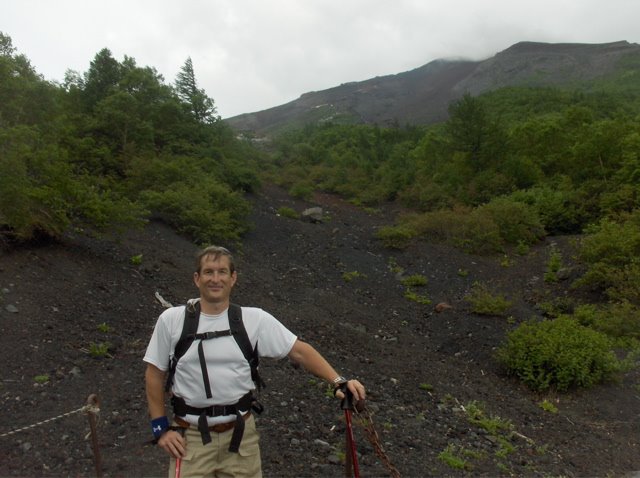
OK, so here we are at the bottom. Like the good fool that I am, I convince my friend "Loose" what a good idea it would be to hike up Mt. Fuji from the bottom. This is not normally done. Normal people start at what is known as the new 5th station, well up the mountain. Only a fool starts at 1st station. And a globe-trotting fool starts well below that, and hikes his lazy butt up to 1st station. You might take a guess as to what we did.
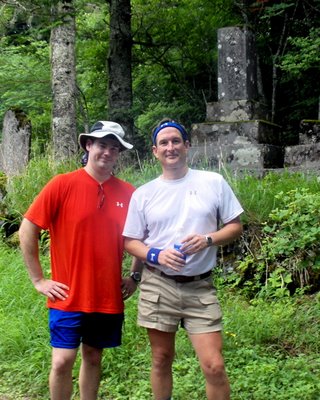
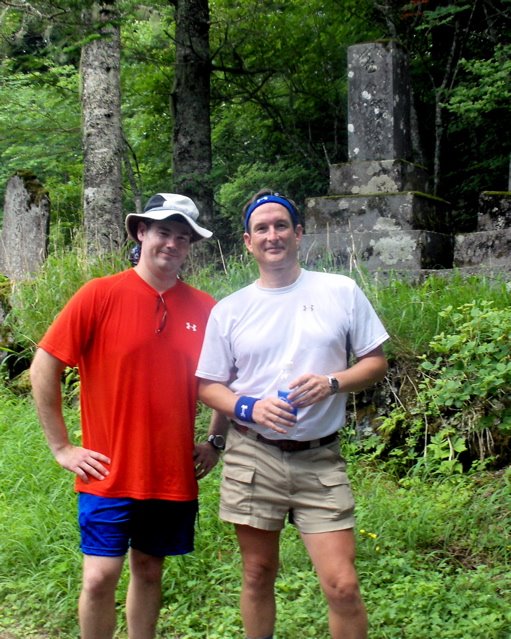
Loose and Steve officially begin
[just click on any photo to enlarge it]
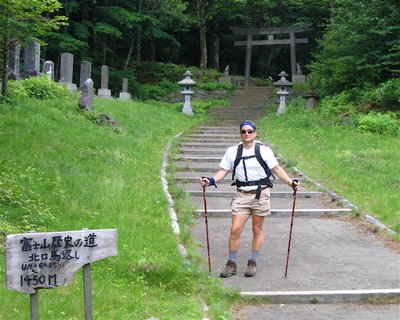
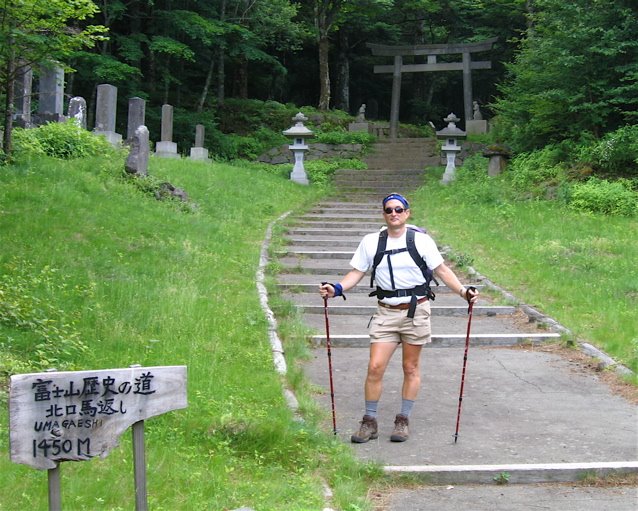
Entering the trail at 1st station
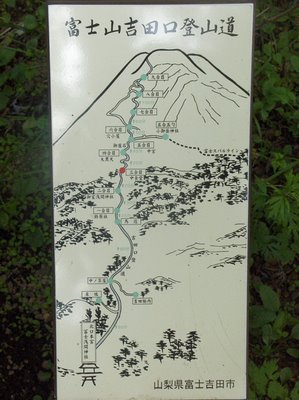
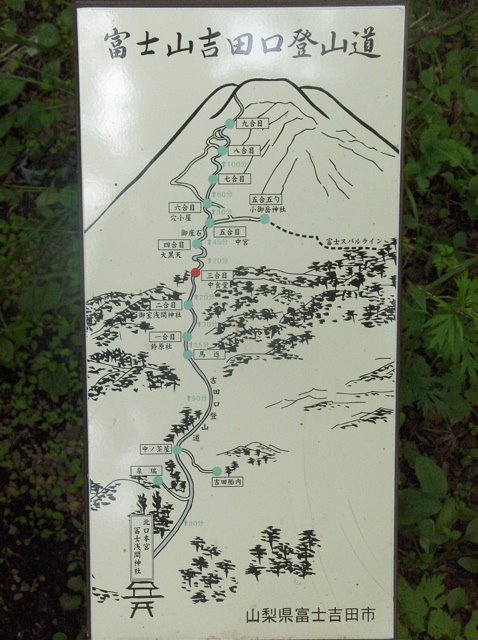
Map of Mt. Fuji from the bottom

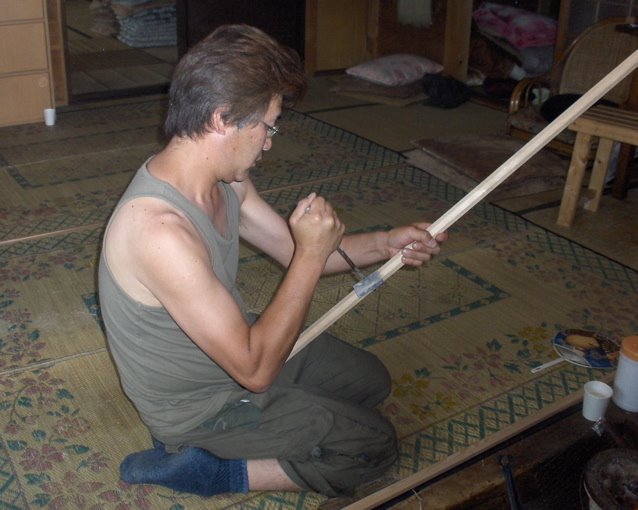
This was Loose's first climb up Mt. Fuji (amazing for someone living in Japan -- he must be really lazy ;-), so he had to get a walking staff branded at each of the manned stations. This is, of course, a racket, but it is also a tradition. We did not get one in town before venturing out, so imagine our relief when the old 5th station sold them. It would have been a long walk across the mountain over to the new 5th station.
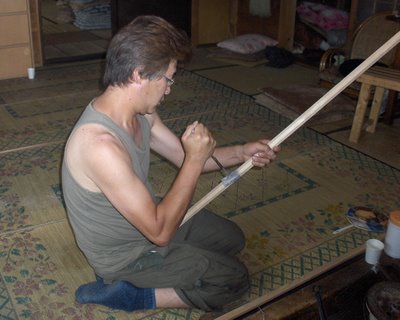
Loose gets his walking stick and the first brand from old 5th station
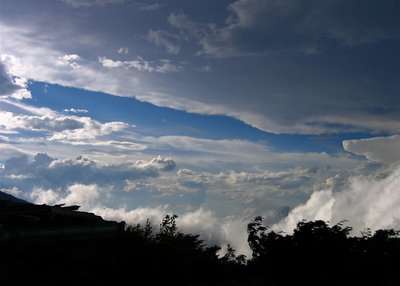
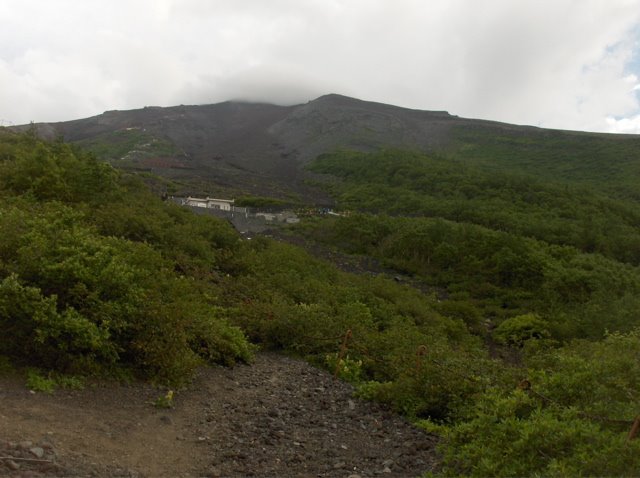
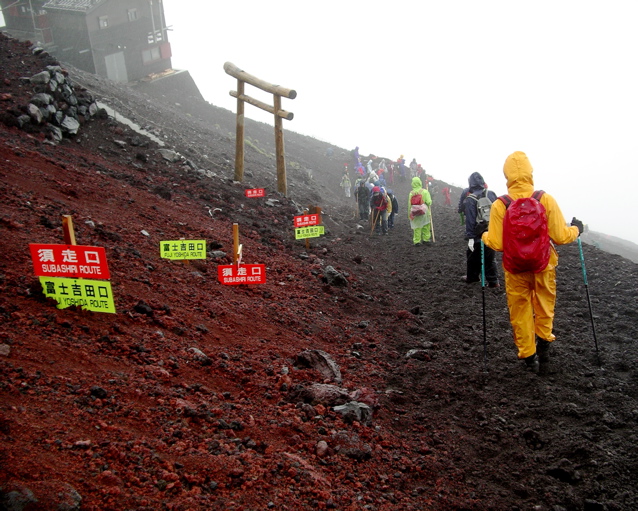
We begin to get some elevation, and enter into the clouds
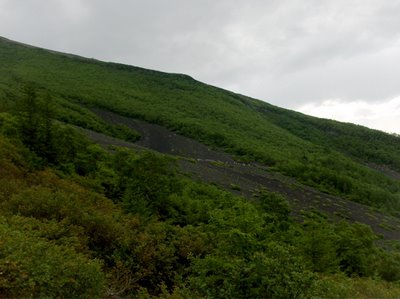
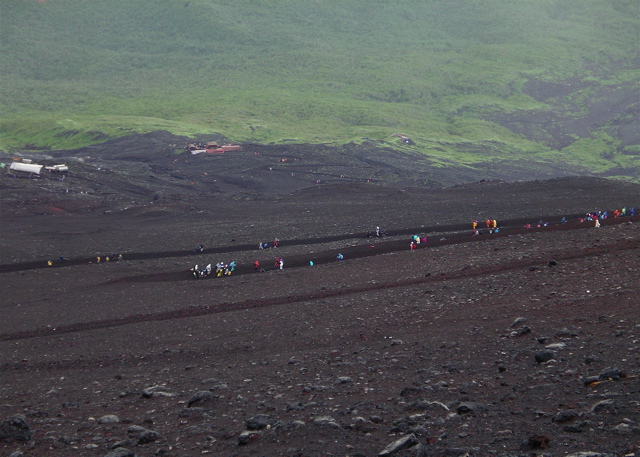
You can see the others crossing over from the new 5th station -- where everyone else starts

The trials merge around 6th station. It has taken us over 6 hours to get to this point, but we still have a LONG way to go. Still smiling though ;-) And now that we are out of the woods (which is the prettiest part of the hike), we can see what awaits us ahead. The trail just gets steeper and steeper (after all, it is a volcano).
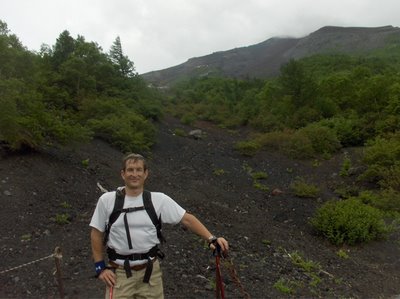
6 hours and still smiling
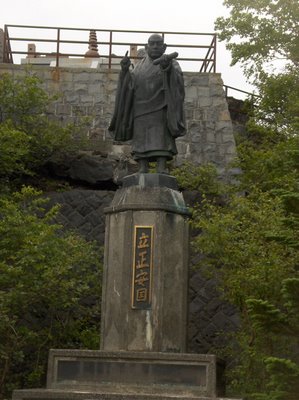
Is he giving us the finger? Not very Buddhist of him
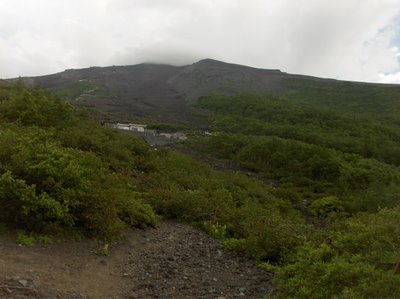
Now we can see what awaits us

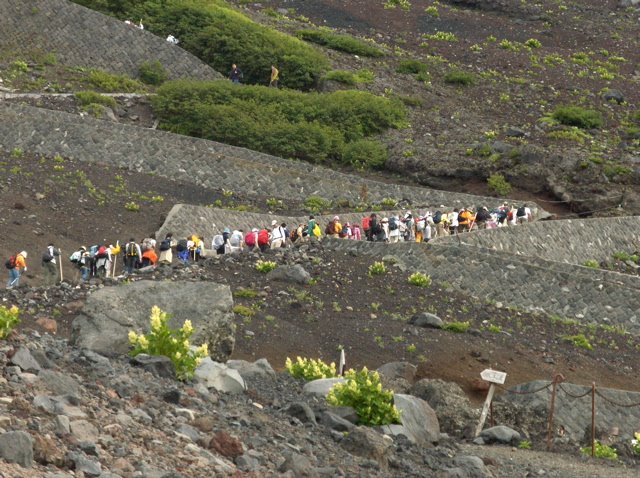
Up till now we've had the trail virtually to ourselves. Pretty amazing given this is the most-climbed mountain in the world! But now we merge with the mass of humanity that helps Mt. Fuji claim that title. And as the trail gets steeper, we will now be hiking switchbacks until we reach the summit. Oh yeah, and it takes so long, we will soon be hiking in total darkness. This is starting to sound fun, isn't it?
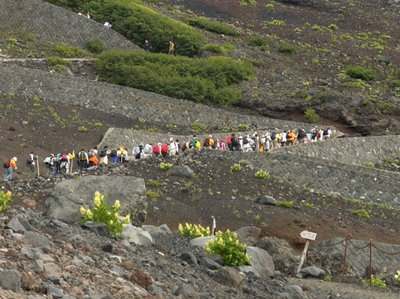
Let the crowds begin
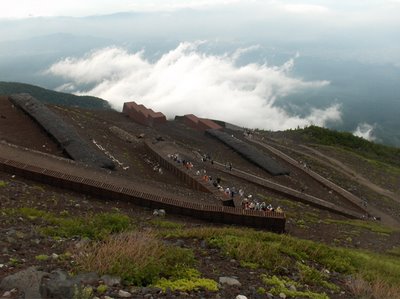
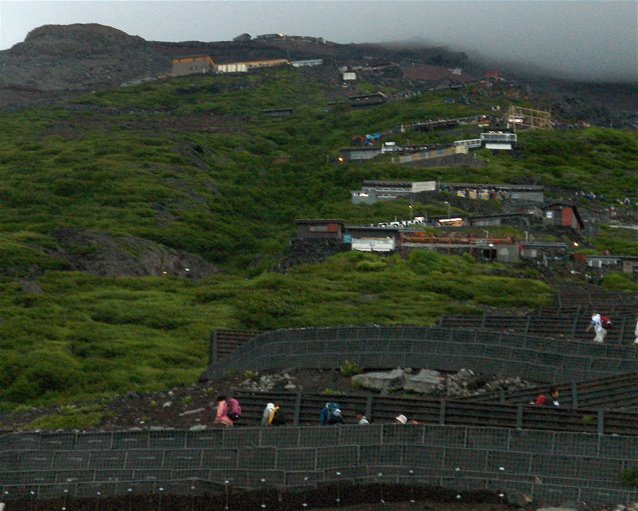
Switchbacks all the way
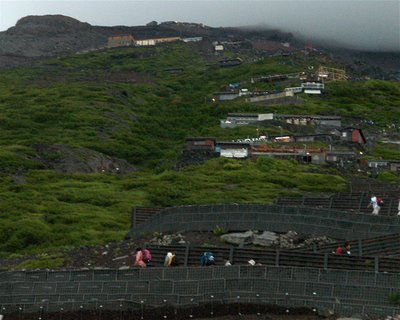
Dusk arrives, and we see the many rest stations along the trail

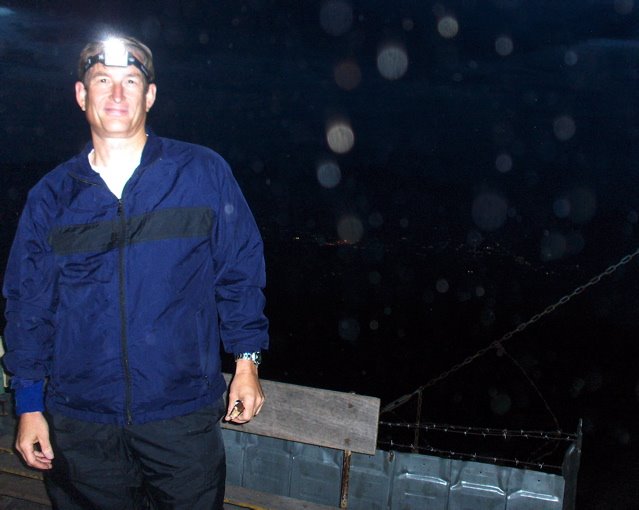
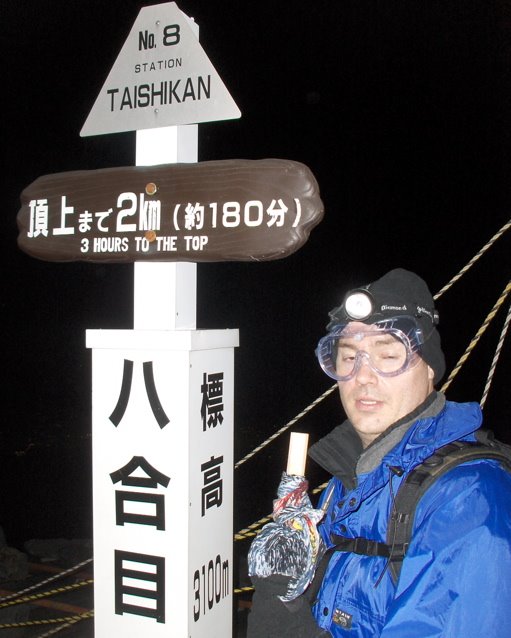
As the sun sets, and darkness encroaches, you can see the city lights below illuminate (if the weather cooperates). So far, so good. It hasn't started raining, but the blowing wind makes its own hazard, and wearing goggles is a good way to protect your eyes. Oh yeah, and you need to break out the headlamp so you can see where you are going.
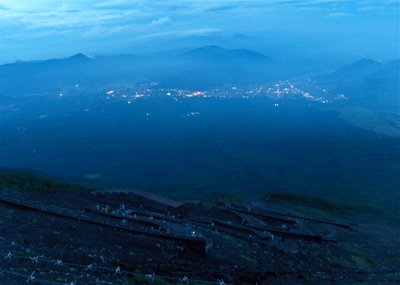
City lights come on

Those flecks are cinders being blown about
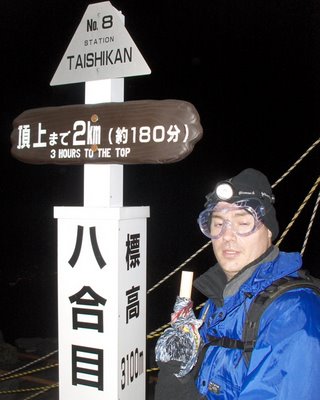
Loose begins "goggle-ops" -- a classic photo if I've ever seen one

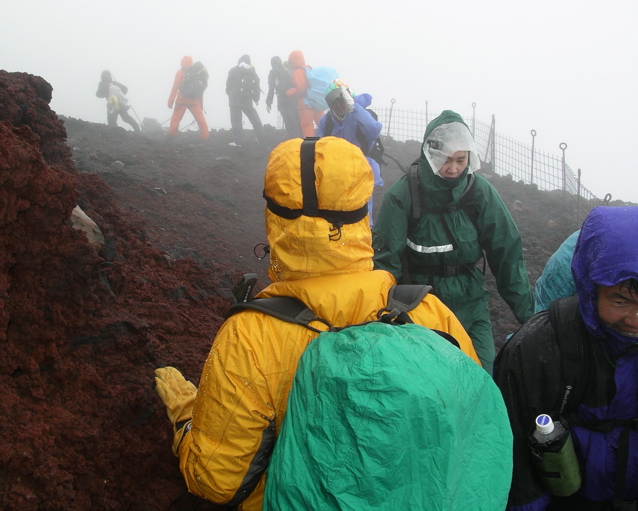
So we head out for our final assault before a very short rest. No pictures of that lovely affair, but imagine crawling though attic rafters, careful not to step upon snoring climbers, all shoehorned in for maximum income. One hour of sleep after 12 hours of climbing. Sounds almost worthless, but it made all the difference. For when we came out, we found we would have to endure soaking rains and driving winds, all the while trapped in a human traffic jam. But finally, near the top, that's the last I see of Loose (after hearing him swear throughout the last 100 meters).
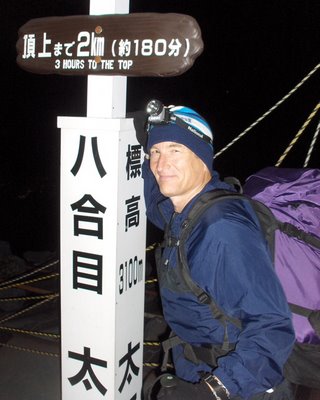
10 hours and still smiling, but a little colder

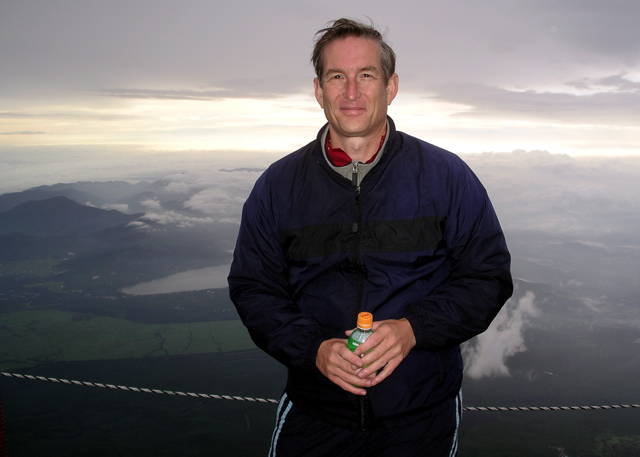
Finally at the top. Time to thaw out!

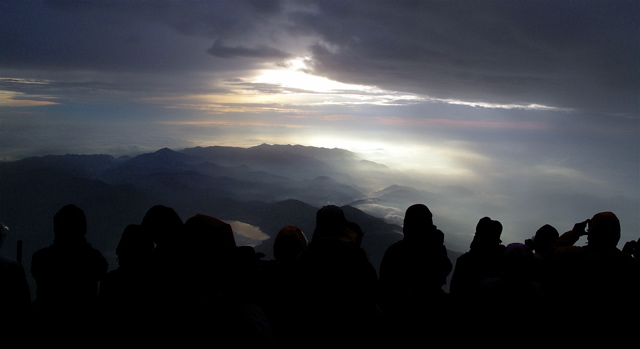
Clouds clear for some pictures

So of course I had to find some shelter to warm up for a few minutes. Then I go out and search for Loose -- but to no avail. As it turns out, Loose (and his gear) had all been soaked, and that is just not fun. So down the mountain he went (leaving his wingman behind - sigh). As the weather clears somewhat, you can still see the climbers coming up, delayed in the human traffic jam, having spent sunrise on the trail. Meanwhile, others, like Loose, are booking it down to the base. But I'm finally warm and relatively dry.
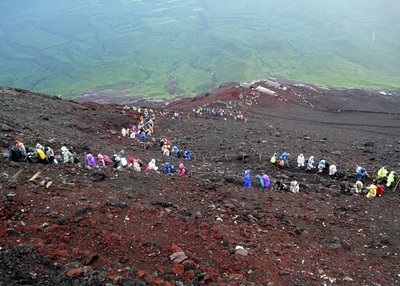
And still they come
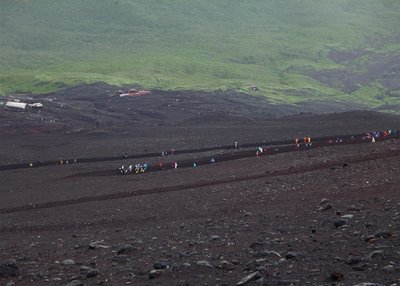
And some head home
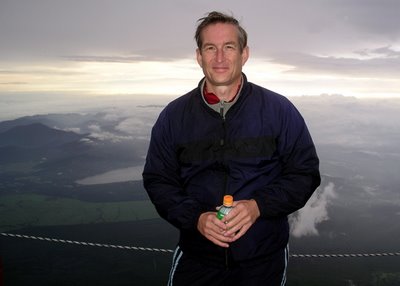
At the top and finally dry

So it's time for a little adventure. Though the weather is turning again, I thought I'd see what the rest of the crater had to offer. I didn't get all that far before the weather totally closed in again, with horizontal rain!
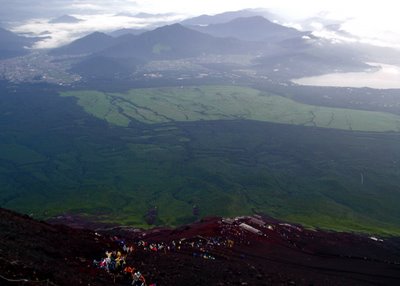
Looking down from the top
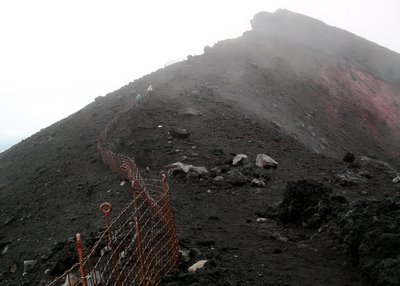
Walking around the crater
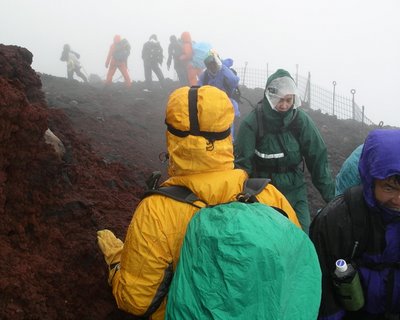
Rounding the corner in 60 mph winds

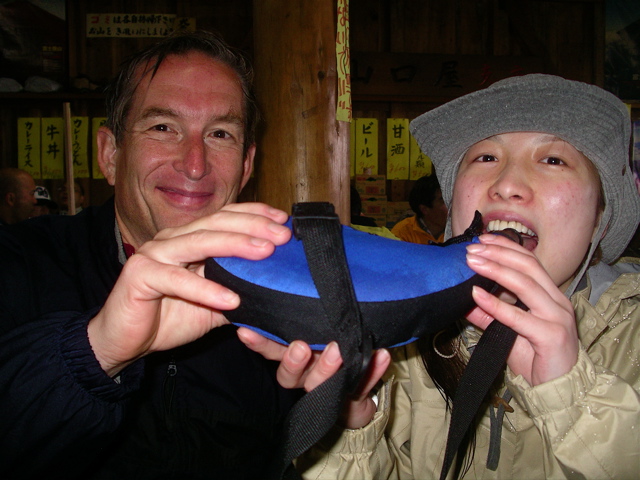
Once again, back in the shelters for warmth and nourishment. Oh yeah, I almost forgot. Loose gave me the sake to carry (I'll do anything for a friend). But alas, no Loose to share it with. Somehow I'll manage ;-) Hey, this must be Loose's birthday present to moi. This was the day before my 49th.
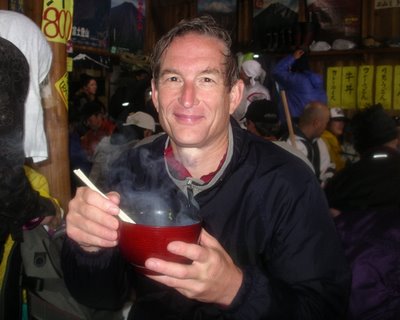
Happy man with hot miso soup
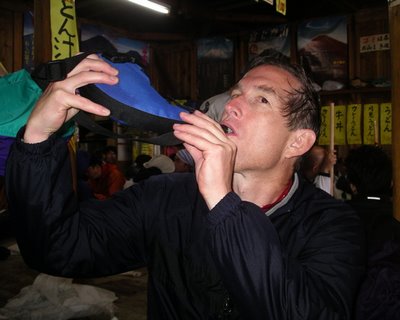
Almost forgot Loose's sake
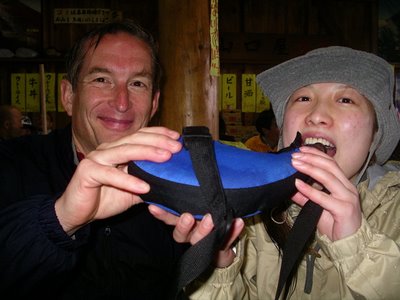
Since Loose is gone -- I have to share it with someone

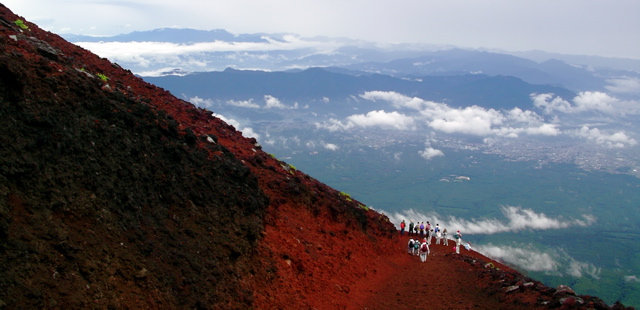
Well, it is time to head down. It's clearing up again, and some of the best views are found on the way down (after all, it's a lot easier heading in this direction). Some of the trails make it look like you could fall right off the mountain. I wouldn't want to lose my footing.
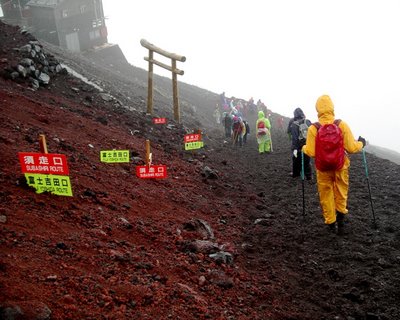
Heading down
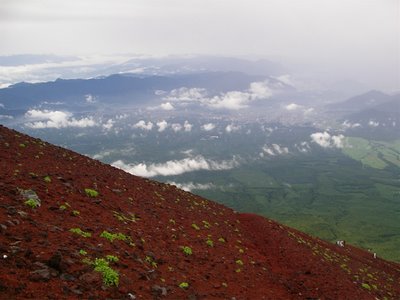
Starting to clear up

Don't fall off

The rain has now stopped for some time, so I guess it's time to rid myself of the giant baggie. It may look funny, but it was the difference between me and my gear staying dry, and Loose and his being soaked and having to head straight down. All in all, it was an enjoyable and picturesque adventure. But I'm still in search of the illusive sunrise on the top.
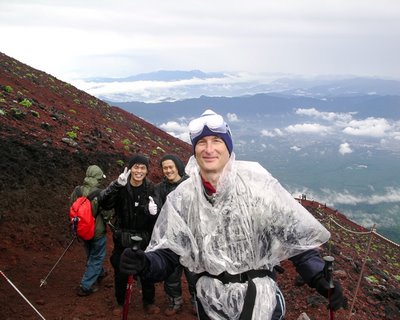
Steve considers cancelling "glad-bag-ops"

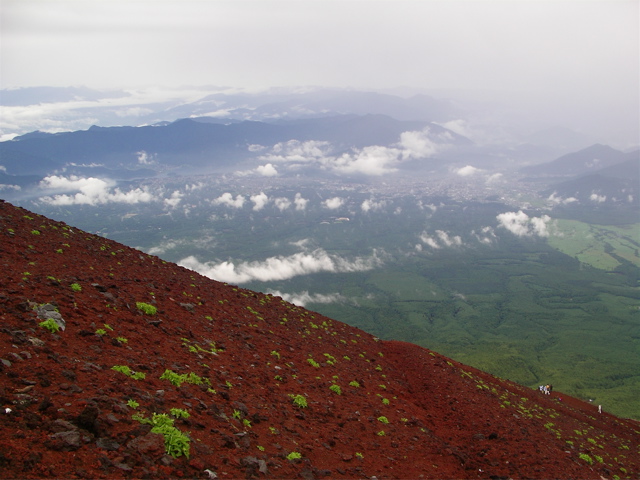
Where lava meets lushness
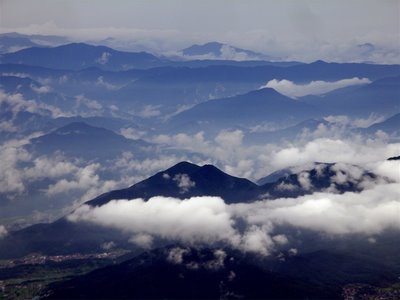
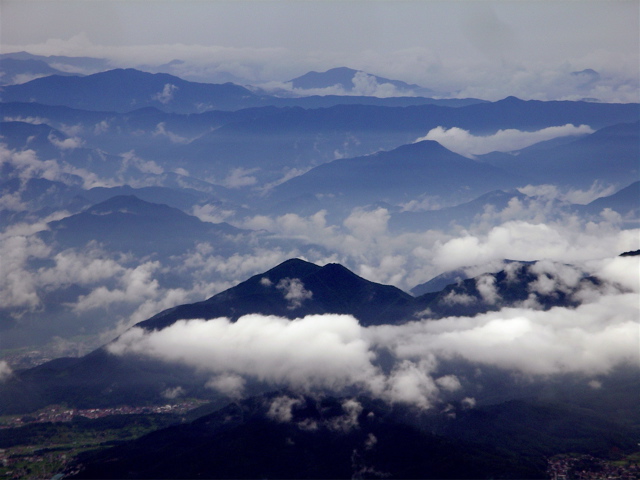
Rippling mountain tops

Which can only mean one thing ... third time must be a charm. Stay tuned for summer of 2007! Who knows -- maybe that's where I'll be on my 50th!

Friday, June 16, 2006

Warm-up on Monadnock Mountain

Grand Monadnock, Dublin, NH, June 2006, HP Photosmart R817, Exposure 1/550 sec @ f4.5, ISO 50, no flash © Steven Crisp

Well, it was planned as a warmup hike in preparation for Mt. Fuji in July. As noted by my good friend Joe, "Going up Monadnock to tune up for a Fuji climb is like going out and getting a haircut to lose weight." Given that wisdom, I've concluded I need to shave my head ;-) More on that later.

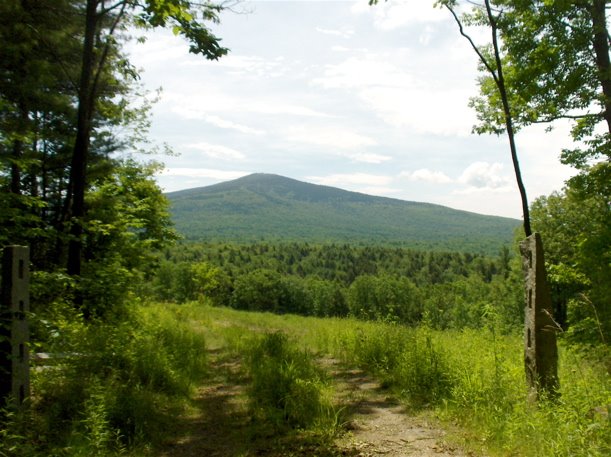
So this is the destination. Most people call it Mt. Monadnock, but that is not its name. Either Monadnock Mountain, or Grand Monadnock. And it is either the #1 or #2 most climbed mountain in the world. The other is Mt. Fuji in Japan. Now to call these both "mountains" seems rather absurd. The peak of Monadnock is 3,165 feet versus 12,387 feet for Mt. Fuji -- barely a fourth in height. But anyways, that is what they say.

This turned out to be a solo outing -- we'll have to talk with the dedicated hikers off-line ;-) Best excuse I heard was contracting Lyme disease -- I'm going to have to remember that one (just kidding Bruce). Anyways, I loaded up my pack with about 40 lbs to see just what kind of shape I was really in (more about that later as well).

Let's Begin. The Dublin trail starts out very gradually in secluded woods for an ascent from the northwest. Though crowds are supposed to be a concern, this trail was virtually barren.

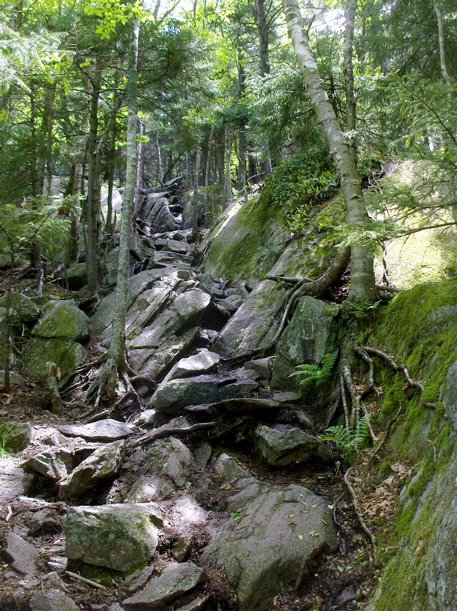
Rocky Ascent. The trail does get rocky rather quickly. Good hiking boots, with lots of support are recommended (more on that later). I also would suggest some trekking poles.

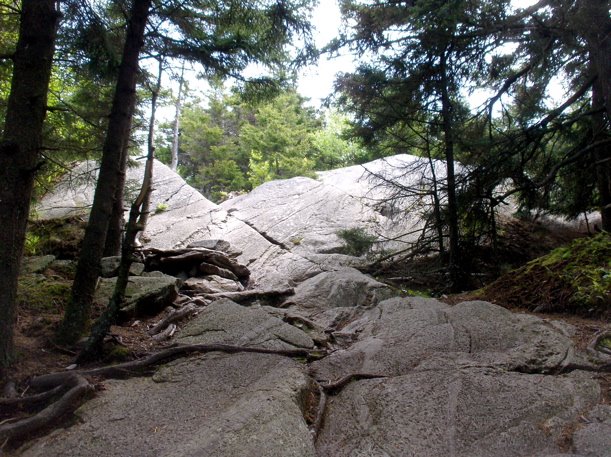
Granite Scrambling. Even more granite, and a little scrambling required. But nothing that presents any problems.

Training with a pack. I decided to hike with a bulky pack to make the hike a little more challenging. Hopefully I can take less up Mt. Fuji. But the only real problem was a hip-strap that was just too high.

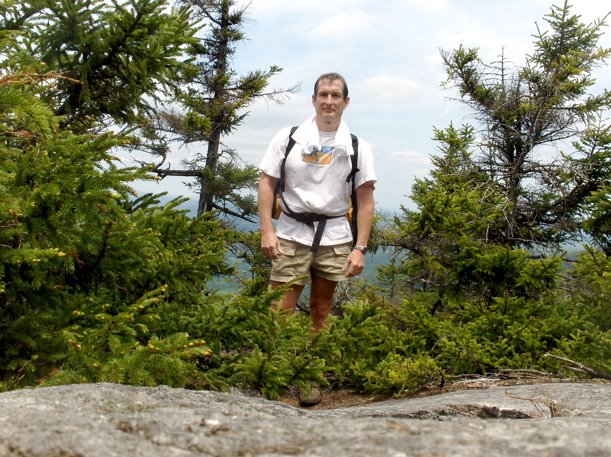
View as you go. This trail does offer periodic views and some breaks in the trees for cooling breezes - very nice.

Getting above the trees. It doesn't take too long to get above tree level. I was hiking at what I thought was a VERY slow pace, but it turned out to take less time than advertised (about 1:50 to the top).

Summit Ahead. Then all of a sudden I heard people talking, and there was the summit, up ahead.

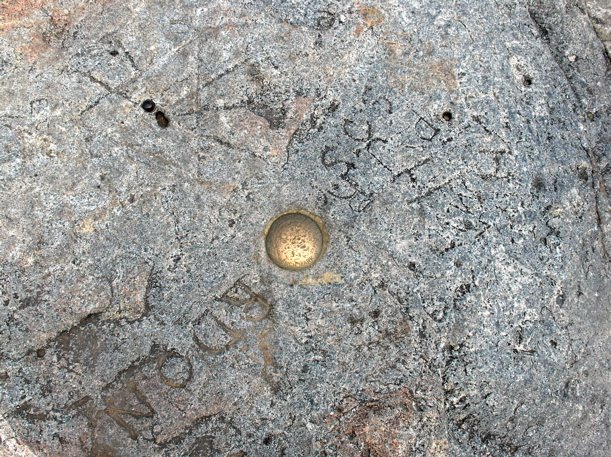
Summit benchmark. Here's my proof ;-) -- actually, you might be interested to know that the summit marker is not the highest point (but close).

Nice cooling breezes. Quite a breeze at the rocky summit -- which felt great on this moderately warm day.

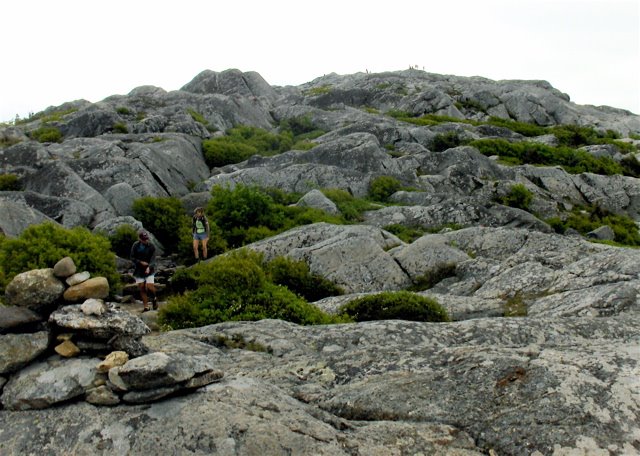
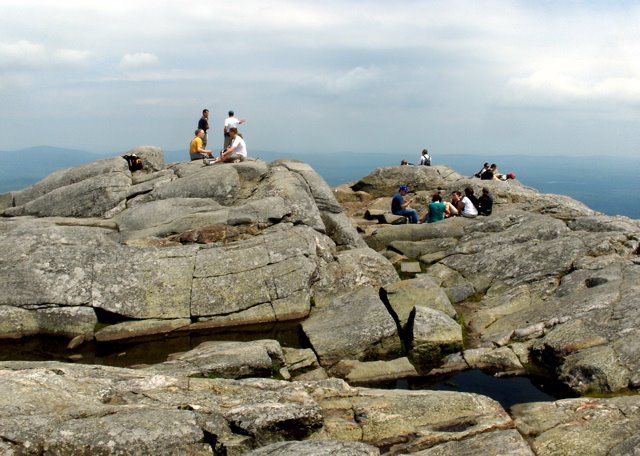
Nothing but granite (and people). I expected actually to find it more crowded at the summit, based on what I had heard reported. But I guess compared to Mt. Fuji which only has a two month climbing season, we have lots of time to spread out the visitors. I even heard there is a local resident that has climbed Monadnock every single day for a couple of years -- wow!

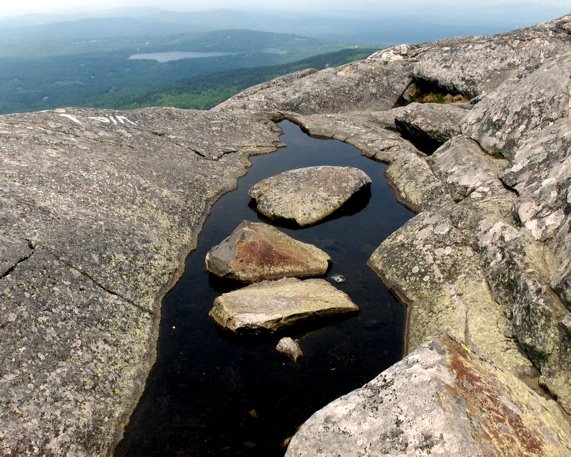
Zen Monadnock. Tipping my hat to Mt. Fuji -- this arrangement made me think of the simple Zen gardens in Japan -- very relaxing.

Yes, that is my laptop. OK, here's the story: First, I needed a heavy pack for training. Second, I had taken my laptop up to the top of Mt. Fuji, so I thought this was the least I could do. Just call me a nerd and be done with it.

No doubt about the way down. They did a great job marking the trails -- no trouble making sure I found my car at the end of the trail.

Trail bottom. Almost down now -- only another 10 minutes to the car.

OK, so here's the rest of the story. You saw the trail on the way up -- somewhat rocky; it is even more treacherous coming down. At least that's what I was thinking as I was carefully navigating my way down. And I made it past all the rocks, boulders, and roots. This is what it looked like when my ankle gave way and I went down. Ouch! I heard something pop, and I knew it wasn't good. About 10 more minutes of hobbling to my car, and then about an hour drive up to our cottage. The end result -- torn ligaments (this has happened once before). Doctor says it is not broken, and hopefully, I'll still be good to go for Mt. Fuji in about a month. Needless to say -- be careful on the way down!

Sunday, January 08, 2006

The End

There is nothing to practice. To know yourself, be yourself. To be yourself, stop imagining yourself to be this or that. Just be. Let your true nature emerge. Don't disturb your mind with seeking.
While I can't tell you who said that, I consider it to be a reasonable conclusion to the Hi-Seekers blog. Let us no longer "disturb our minds with seeking."

There is nothing to seek; no place to go. We have everything we need, and always have. We only have to realize this. And the best way to gain this insight is by peeling back the layers of conditioning we have accumulated. In short, we have to "undo" this conditioning, and look inward. As such, all hi-seeker posts, and related future discussion, has moved over to my Just Un-Do It blog.

You might also be interested in my daily posts of photographs and reflections on my Reflections of Beauty blog.

I hope to see you over there!

Saturday, December 17, 2005

Living vicariously


Haven't we all experienced what it means to live vicariously through others? Sometimes the circumstances are such that we cannot be in the same place, at the same time, or under the same conditions as another, and yet we can still benefit from their experiences. I had that experience today, when I stumbled upon this blog. As strange as their circumstances are (walking across India, getting by on less than $1/day, and living a life a service), I believe you will gain immeasurably from this blog, and I recommend it to you.

The story that I found very fascinating, and it represents a specific example of Paying It Forward, is called Unspoken Contract With a Rickshaw Driver. (Hence my photo, which is of a tuk-tuk and its driver, but perhaps you get the idea.) Anyway, I think you'll find his writing interesting, and the story compelling. Let me know what you think.

S-

p.s., not willing to leave well enough alone, I read some more of this blog and came across a related story entitled 400 Rupee Tip At the Seva Cafe. You'll have to read it to believe it. This is happening now, in India. This is NOT the Hollywood sequel to Pay-It-Forward, the movie. Calling all idealists; calling all cynics ... Can you believe it? Can it happen here? Are you going to be a part of it?

Thursday, December 01, 2005

We are all interconnected (part 1)

This is a common refrain from Buddhists and other spiritual folks, right? But what does it mean? Is it some metaphysical or philosophical or simply spiritual concept? I'm reading a book by Thich Nhat Hanh, a well-known Vietnamese Buddhist monk and peace activist, entitled Essential Writings, from 2001. In the second chapter, he takes a crack at this concept, and I think presents a very compelling case. He calls the concept interdependence and inter-being.

Here's the premise. Take a piece of paper in your hand and look at it. It's a separate "thing" right? An unconnected entity unto itself? Whoa, not so fast. Look closer at the paper, and see if you can see the sun in it. You know, the sun that gave light to the tree, which perhaps you can also see in it. And the clouds, can you see them also? Of course they gave themselves up in the form of water to enable the tree grow. And maybe you can see the wheat -- a little harder perhaps, but look closely. Can you see the wheat that made the bread that fed the logger that cut the tree? Maybe now you get the idea -- and perhaps you think it is just a word game. But is it?

It's certainly true that all of that was needed (and of course so much more) to produce that piece of paper. So much that it is in fact a part of that paper, because without any one of those, that paper would not exist. This is Thich Nhat Hanh's concept of inter-being. All these things are an integral part of the being of that paper. The paper can't exist by itself, so it 'inter-is' with all those other elements. And when you really consider it, everything is connected and essential in everything.


Take another example. The beautiful orchid you see in the picture above is truly splendid. Now think about your garbage. You probably just run it down your garbage disposal, but if you put it in a pail it would become, over a few days, rotten and putrid, and really quite disgusting. But that's not seeing the interconnectedness of all things. If you cut that orchid, and put it in a glass, it will stay fresh and beautiful for a few days, and eventually start to wilt, and then rot. It will become the garbage, and therefore it has its garbage-nature in it all the time. Similarly, that garbage will rot and turn into compost, which can then fertilize the orchid plant, and together, and only together, can they make the beautiful orchid flower. So that garbage has orchid-nature in it all the time as well.

What is the point of this thought exercise? Well first, to realize that this isn't a "game" but is in fact the true nature of things. Things do not exist in and of themselves in isolation. We are tied inextricably to our environment. Indeed, we are all interconnected.

And from our Native American brothers:
Humankind has not woven the web of life. We are but one thread within it. Whatever we do to the web, we do to ourselves. All things are bound together. All things connect. -- Chief Seattle

More later ...

S-

Sunday, November 27, 2005

Who Are We in Between our Thinking?

I have been participating in a 5 Week Course in Mindfulness Meditation ("Vispana" in the parlance of Buddhism). The course is being taught by Gil Fronsdal at the Insight Meditation Center in Redwood CA. Although there has been a lot building up to what I am talking about here, I thought I would share some insights into something that was taught in the course today.

The question is: "Who are we in between our thinking?" Mindfulness draws awareness to the fact that we spend much of our time caught up in various thinking processes, for example, planning for the future. During Mindfulness meditation, we seek to recognize this process for what it is, and in turn provide ourselves with a sense of freedom and liberation. Fronsdal points out that as humans, there is an epidemic of the following process:

- Something happening to us, or a thought arises
- This thought or eventleads us down a path of: if I do this, then this will happen, then this will happen, then this will happens and therefore this will happen ... etc.
- We then walk around in these thinking processes, not living in the moment for minutes, hours, days ....
- Then we run into other humans who are engaging in similar webs of thought and not living in the present
- So here are two humans down two wholly independent "rat holes" trying to have a meaningful interaction in the present moment

While Mindfulness Practice does not judge thinking as bad, it teaches us to recognize thinking for what it is, and look at it as somewhat of of an outsider. We then come back to the breath as the center of our attention, trying to "live in the breath" in the present moment.

There are also some further investigations which might be made during the meditation, such as recognizing that the thinking is only a flag for some underlying emotion. For example, fear might bring one to an intensive planning process. That thinking tries to bring us to a point of safety psychologically. In that case, with Vispanan practice, you gently recognize the emotion, don't judge it as good or bad, simply put it aside, and then come back to the breath.

So the question again: "Who are we in between our thinking?" I would be curious to hear some answers to that. This Holiday Season, if you turn off that voice in your head that's planning the presents, the tree, the time off from work at the office; then who are we in those independent moments without thinking? Some people are afraid of it. I can say that personally I have been able to catch glimpses of this and I think it is a very beautiful thing that can bring a greater sense of pleasure to the things that are going on around us in the present.

See if you can for just a few moments sit quietly, close your eyes, and turn off the voice inside your head, and only observe your breathing. See if during the day you can recognize when you are going through elaborate (and perhaps somewhat unnecessary) webs of planning, or lament about past mistakes or missed opportunities (for example). How does this thinking prevent you from fully engaging in the present and experience life to the fullest?

Thursday, November 24, 2005

Can you be Thankful for another long post?

Happy Thanksgiving to those that celebrate the holiday. With so much to do and prepare, traveling to be done in possibly foul weather, concern about overeating and anticipation of initiating the marathon Christmas shopping, it is sometimes possible, at least for me, to forget to be "Thankful". [Yes, this photo is of our dog Frito, taken on Thanksgiving Day, 2005, in New England.]

But in the quiet times, when I reflect on life, the world, and our purpose, it becomes very clear that Gratitude is an excellent mechanism to help focus on the Now, see the beauty amongst that which is not so beautiful, and recognize just how insignificant our trials and tribulations are (even when they seem so overwhelming).


And from this attitude of gratefulness, bubbles up a spring of compassion, love, and generosity -- which feeds the pool called Lovingkindness -- that will ultimately flow into contentment, enrichment, and joy. What a great practice.


May you use Thanksgiving as a reminder of the value of this daily practice of Selfless Gratitude. And since I'm no expect, I've included an article below from this month's Yoga Journal that better explains the concept.

S-

Selfless Gratitude

Through the mindfulness practice of gratitude, you are able to rejoice amidst all life's suffering.

By Philipp Moffitt


Students leaving a meditation retreat will sometimes ask me to recommend a mindfulness practice they can incorporate into their daily routine that will keep them in touch with the experiences they've had during the retreat. There are many such practices, but occasionally I suggest one that almost always surprises them and sometimes draws skepticism—the mindful cultivation of gratitude. Gratitude is the sweetest of all the practices for living the dharma in daily life and the most easily cultivated, requiring the least sacrifice for what is gained in return. It is a very powerful form of mindfulness practice, particularly for students who have depressive or self-defeating feelings, those who have access to wonder as an ecstatic state, and those with a reactive personality who habitually notice everything that's wrong in a situation.

The Buddha taught that every human birth is precious and worthy of gratitude. In one of his well-known analogies, he said that receiving a human birth is more rare than the chance that a blind turtle floating in the ocean would stick its head through a small hoop. He would often instruct a monk to take his ground cloth into the forest, sit at the base of a tree, and begin "gladdening the heart" by reflecting on the series of fortunate circumstances that had given the monk the motivation and ability to seek freedom through understanding the dharma.

Practicing mindfulness of gratitude consistently leads to a direct experience of being connected to life and the realization that there is a larger context in which your personal story is unfolding. Being relieved of the endless wants and worries of your life's drama, even temporarily, is liberating. Cultivating thankfulness for being part of life blossoms into a feeling of being blessed, not in the sense of winning the lottery, but in a more refined appreciation for the interdependent nature of life. It also elicits feelings of generosity, which create further joy. Gratitude can soften a heart that has become too guarded, and it builds the capacity for forgiveness, which creates the clarity of mind that is ideal for spiritual development.

Let me be clear: The practice of gratitude is not in any way a denial of life's difficulties. We live in troubling times, and no doubt you've experienced many challenges, uncertainties, and disappointments in your own life. Nor does the practice of gratitude deny the Buddha's teaching on death: Death is certain; your death is certain; the time of death is unknown; the time of your death is unknown. Rather, gratitude practice is useful because it turns the mind in such a way that it enables you to live into life or, more accurately, to die into life. Having access to the joy and wonderment of life is the antidote to feelings of scarcity and loss. It allows you to meet life's difficulties with an open heart. The understanding you gain from practicing gratitude frees you from being lost or identified with either the negative or the positive aspects of life, letting you simply meet life in each moment as it rises.

In the Bible the disciple Paul instructs, "In everything give thanks." What he means is that from your limited perspective it is not possible to know the outcome of any event. What can seem unfortunate at first may turn out to be an unforeseen blessing.

There is a very old Sufi story about a man whose son captured a strong, beautiful, wild horse, and all the neighbors told the man how fortunate he was. The man patiently replied, "We will see." One day the horse threw the son who broke his leg, and all the neighbors told the man how cursed he was that the son had ever found the horse. Again the man answered, "We will see." Soon after the son broke his leg, soldiers came to the village and took away all the able-bodied young men, but the son was spared. When the man's friends told him how lucky the broken leg was, the man would only say, "We will see." Gratitude for participating in the mystery of life is like this.

The Sufi poet Rumi speaks of the mystery of life coming from God in his poem "The Guest House": "This being human is a guest house / Every morning a new arrival. / A joy, a depression, a meanness / some momentary awareness comes as an unexpected visitor. / Welcome and entertain them all! / Even if they're a crowd of sorrows / who violently sweep your house empty of its furniture. / Still, treat each guest honorably. / He may be clearing you out for some new delight." (The Essential Rumi. Coleman Barks, HarperSanFrancisco, 1995.) Gratitude practiced in this manner brings delight, balances out your tendency to focus on the negative, and can even lift a dark mood.

Counting Your Blessings
There are numerous ways to use mindfulness to cultivate gratitude. Of course you acknowledge your appreciation when things are going well. But even more helpful is to notice those things for which you are grateful when you are contracted physically or emotionally. I often instruct students to respond to a difficult situation by acknowledging it as such, then saying to themselves, "Yes, this is terrible, and I am grateful for . . . ." An example would be, "I am angry at this moment, and I am grateful I have a mind which knows this is so and can deal with it." I also encourage students to focus on the wonderment of nature and the human capacity for learning and creating. It is so easy to only notice the terrible aspects of human beings so that wonderment is often forgotten.
You can reflect on gratitude by inquiring if it is time-based. Ask yourself what happened to all the gratitude you have felt in the past? Where did it go? Do you believe that gratitude is dependent on feeling good right now? If so, isn't that a very small-minded, "what have you done for me lately?" attitude? Would it not imply that your gratitude is contingent upon an exchange—as long as you feel good, you will be grateful, and if not, forget it. This is not the quality of gratitude that leads to a mystical, direct experience of life; it is an unskillful blackmail or emotional demand on the universe.

You can also practice being consciously grateful to your family, friends, teachers, benefactors, and all those who have come before you who have made it possible for your existence to be comfortable, informed, and empowered. Take a few minutes at the end of each day to mentally note the many people who have invisibly served you by providing medicine, shelter, safety, food, and education.

If you were asked to make a list of things for which you are grateful, how long would this list be—20 items, 100, 500? Most likely you would include your health, your mind's ability to function well, family, friends, and freedom. But would it include the basics, like a safe place to sleep, clean air and water, food, and medicine? What about for Earth itself, blue skies, a child's laughter, a warm touch, the smell of spring, the tang of salt, the sweetness of sugar, or that morning cup of coffee?

The making of such a list is not meant to make you feel indebted but is intended to clarify your understanding of how life really is. It is a reflective meditation that uses mindfulness to carry you beyond the superficial to a deeper experience of your life unfolding moment by moment. You learn to throw off the blinders of habitual assumptions that prevent you from perceiving the miracle of life.

The next step in gratitude practice is to actively notice things you are grateful for throughout your regular day. For instance, when you're stuck in traffic and it's making you late and irritated, you notice you can be thankful you have transportation and that other drivers are abiding by the agreed-upon driving rules, which prevent chaos and unsafe conditions. In other words, there is a level of well-being and community cooperation that is supporting you even in the midst of your bad day. And you do this not just once or twice, but a hundred times each day. You do so not to get out of a bad mood or to be a nicer person, but with the intention of clearly seeing the true situation of your life. Traffic remains frustrating, but the inner experience of how your life is unfolding begins to shift. Slowly you become clearer about what really matters to you, and there is more ease in your daily experience.

You might ask yourself about your "gratitude ratio." Do you experience the good things in your life in true proportion to the bad things? Or do the bad things receive a disproportionate amount of your attention, such that you have a distorted sense of your life? It can be shocking to examine your life this way because you may begin to realize how you are being defined by an endless series of emotional reactions, many of which are based on relatively unimportant, temporary desires. When you look at how much griping you do versus how much gratitude you feel, you realize how far off your emotional response is from your real situation. The purpose of this inquiry is not to judge yourself but rather to motivate yourself to find a truer perspective. Why would you want to go around with a distorted view of your life, particularly when it makes you miserable?

Without instruction, reflecting on gratitude can seem boring or sentimental, evoking memories of your mother admonishing you to eat all the food on your plate. Part of the confusion is that many people have come to equate gratitude with obligation. But real gratitude begins as appreciation for that which has come into your life. Out of this appreciation, a natural, spontaneous emotion arises that is gratitude, which is often followed by generosity. When gratitude comes from indebtedness, by definition what's been given cannot have been a gift.

There is a shadow side to gratitude, in which reality gets distorted in yet another way. It manifests as a hopeless or helpless attitude disguised as gratitude, and it expresses itself in a self-defeating, passive voice—"Yes, these things are wrong and unfair, but I should be grateful for what I have," or "At least we have this," or "Compared to these people, look how much better off we are." This voice, whether it is an inner voice or comes from someone else, is not to be trusted. Gratitude is not an excuse for being passive in the face of personal or societal need or injustice. You are not excused from working to become a caring person, creating a better life for your loved ones, or protecting the innocent. Acknowledging the great gift of a human life through gratitude is just the opposite; it is a call to action to be a caring human being while acknowledging the folly of basing your happiness on the outcome of your actions.

Shortchanging Gratitude
Many students ask, If experiencing gratitude feels so good, why do we often shortchange it? If you will answer this question for yourself, you will gain much insight into how you make your life more difficult than it need be. Sometimes you shortchange gratitude because your mind is stuck in problem-solving mode; it only notices what isn't working and sets about trying to resolve it. This might seem desirable, but in fact there will always be things wrong in your life. So you reduce your experience of being alive if you are only responding to the negative. Is that what you want out of life? Do you really want to delay your sense of being alive while you await a future, perfect moment that is unlikely to arrive?
A second reason you might shortchange gratitude is related to the first: The mind tends to take for granted whatever is both desirable and present. This happens because the mind wants constant stimulation, and whatever is present and pleasant tends not to create that stimulation. You can see this for yourself around eating a favorite food: Notice how the first few bites taste so delicious, then how quickly the mind ceases to register the pleasant sensations. It is like this with everything—a cool breeze on a hot day, the sound of a stream as it flows over rocks, the freshness of the morning air after a rain. They all simply disappear from consciousness in the untrained mind. However, a mind trained in mindfulness of gratitude will stay attuned far longer and note more details of that which is good.

The phenomenon of comparing mind is another hindrance to practicing gratitude. It is the aspect of your mind that notices, "She has a nicer car than I do," "He is stronger than I am," or "She is a better yogini than I am." Understand that there is a difference between discernment, the factor of mind that sees things clearly, and comparing mind, which exercises judgment and hides a belief system that says, "If only I have more of the right things, I will be happy." This is a false belief, of course, a mental habit really, but because it is unacknowledged and seldom examined, it holds enormous power in your life.

Unrecognized arrogance arising from a hidden sense of entitlement can also be an obstacle to practicing gratitude. When you have a strong feeling of entitlement, you don't notice what is going well, but rather what is not right. It can stem from a sense of either having suffered unfairly or having been deprived. It can also arise from feeling special because you are smart, a hard worker, or successful. At the subtle level of mindfulness, this arrogance is a form of ignorance where these two truths of life are mixed together.

Finding Grace Through Gratitude
The words "gratitude" and "grace" share a common origin: the Latin word gratus, meaning "pleasing" or "thankful." When you are in a deep state of gratitude, you will often spontaneously feel the presence of grace. The grace in receiving a human life is that it grants you the capacity to experience that which is beyond the mind and body—call it God, emptiness, Brahman, Allah, or the Ground of the Absolute.
Reflect on this: You, with all your flaws, have been chosen for this opportunity to consciously taste life, to know it for what it is, and to make of it what you are able. This gift of a conscious life is grace, even when your life is filled with great difficulty and it may not feel like a gift at the time.

When Henry Thoreau went into retreat at Walden Pond, he and his friend Ralph Emerson had been studying Hindu, Buddhist, and Taoist texts. He wrote: "I went to the woods because I wished to live deliberately, to front only the essential facts of life and see if I could not learn what it had to teach, and not, when I came to die, discover that I had not lived." He understood that conscious life was a gift for which the highest form of gratitude was to know it in all its depths.

This grace of conscious life, of having a mind that can know "this moment is like this," is the root of all wonder, from which gratitude flows. The wonder, the mystery, is that you, like everyone else, are given this short, precious time of conscious embodiment in which you can directly know life for yourself. However you find life to be—cruel or kind, sorrowful or joyous, bland or stimulating, indifferent or filled with love—you get the privilege of knowing it firsthand.

Gratitude for the grace of conscious embodiment evolves into the practice of selfless gratitude, in which your concerns slowly but surely shift from being mostly about yourself and those close to you to being about all living beings. As this occurs, you need less and less in the way of good fortune. It becomes enough that there are those who are happy, who are receiving love, who are safe, and who have a promising future. It is not that you would not prefer good things for yourself, but your sense of well-being is no longer contingent on external circumstances. You are able to rejoice that amidst all life's suffering there exists joy. You realize that pain and joy are part of a mysterious whole. When this state of selfless gratitude starts to blossom, your mind becomes more spacious, quieter, and your heart receives its first taste of the long-sought release from fear and wanting. This is grace.

"Dharma Wisdom" columnist Phillip Moffitt is a member of the Spirit Rock Teachers' Council in Woodacre, California, and the founder and president of the Life Balance Institute. He teaches vipassana meditation at Turtle Island Yoga Center in San Rafael, California. For a retreat schedule, check www.lifebalance.org.

Wednesday, November 23, 2005

Happiness and Love (Not Love and Happiness)

Grasshopper posts ...

I'd like to put a few things together:

 - I think if we had the opportunity to ask God the question:  "Why am I here?"  The answer would be "To Love."
 
 - A friend of mine who I met in Bangkok recently explained to me his philosophy of life over beer which goes something like this:  "It is our *responsibility* in life to make ourselves happy.  In doing so we make those around us happy and thereby spread love."  So according to him, this is not just something that is "nice to do."  But it's a responsibility.
 
 - "Option," a philosophy of life taught at the Option Institute in western MA teaches us that we indeed are responsible for our own happiness.   According to Option, we make a choice every day that our feet hit the ground:  We can be sad or happy.  Option makes no negative judgement about the choice to be sad, it simply makes people realize that it is a conscious choice that we make every day.
 
 -  Buddhism teaches (as I understand it) that we have a fundamental responsibility to take care of ourselves.  It's not selfish, but a realization that only in caring for ourselves, can we then take care of others.  This "Precept" also keeps us from getting preoccupied with the business of others.
 
 What do these things put together to mean?  When we are faced with difficult decisions in life, decisions which we think will lead us to happiness, it's our responsibility stick our necks out.  We can feel all kinds of distracting things such as "I don't deserve this" (undue guilt), or "I may fall flat on my face" (irrational fear).  We may fall flat on our faces and in the process learn from our mistakes.  However only in taking full responsibility for our lives, and in taking the chance, do we discover the way to our true happiness, and are ultimately able to love others to our full potential.
 
 I am not saying that we act irresponsibly.  The choices need to be well thought and not involve unnecessary risk.  However, only in becoming the happiest person that we can be, do we afford ourselves the opportunity to love and help others "to the Max."  These decisions will involve courage.  I always remember what Shakelton said:  "Optimism is the True Moral Courage."  
 
 Here's the quote that precipitated this thinking:
 
 Weekly Wisdom Message November 21, 2005
 
 CORRELATION:
 
 I noticed
 the happier I am,
 the more loving
 I am.
 It was nice
 to notice that. 
 
 Reprinted from Out-Smarting Your Karma.
 Copyright © 1996 by Barry Neil Kaufman.
 All Rights Reserved. Published by Epic Century
 Publishers.
 
 Request our FREE brochure:
 http://www.option.org/i_lit.html.

Sunday, November 06, 2005

Accepting Acceptance


Well, we had a spectactular weekend in Cambridge for our little Buddhist retreat. jim and I took in both the Friday evening "executive summary" and the Saturday "apparently you don't have a life" all-day session. We had a great time, and couldn't have asked for better weather. I also want to thank jim's friend, Patty, who let me crash at her place in Lexington to save some driving time, as well as have some nice conversation.

And the retreat was great, and I'll highly recommend it to any who want to find out more about Buddhism from a very down-to-earth teacher, Lama Surya Das. Check it out in my links 'Buddhism for the West of us'. [And you can blame me for the pun.]

So what did I learn? Well, actually, quite a lot, so let me see if I can express one aspect of it. For those (few) of you that have followed this Seekers list for quite some time, you may recall some discussion a while back about what I saw as a possible contradiction in Buddhism: a desire to "change the world" (aka reduce suffering) and a recognition that "everything is perfect just as it is". So I asked about this. And the answer was (in retrospect) pretty obvious. For those that see the world in black and white, seek out the middle way (which is what Buddha taught). These apparent contradictions are simply a reflection of a dualistic world view. Basically, having some "acceptance" (of the world, of yourself) goes a long way toward breaking down the apparent dichotomy.

Segue to a bucolic Lexington street, the next morning, where I was taking an early walk. I was watching a group of squirrels playing in the trees. My wife and I had previously noted that there are very few acorns this year (especially compared to the bumper crop last year), so I was thinking about how "bad" that would be for the squirrels. Then I got it. That's not "bad." That is just the way it is. Which by the way is the key to Buddhism -- recognizing the world as it really is, and not getting caught up in the duality and relativism of good and bad.

So by accepting the world (or a person, or yourself) as it is, you can approach it with detachment from the outcome, and still be the best person you know how to be (most compassionate, most patient, most forgiving, most generous, most wise, you get the idea). Surely that will contribute to less suffering (even if only in yourself). And perhaps more subtley, you can begin to accept that which many see as "bad", and on a good day, like we had on Saturday, you might even begin to see its beauty.

Segue to apparently totally unrealated topic, but hold on for just another minute.

I'm reminded of a movie I saw not long ago: American Beauty. Have you seen it? It is a remarkable film (once you get past the dysfunctional families). I was particularly taken by the character Ricky Fitts, the neighbor 'psychopath' that videotapes everything. Does anyone remember the scene (or did I just make this up) where he was describing seeing a homeless woman that had frozen to death the night before, and he couldn't stop looking because it was so ... what? Disgusting? Depressing? Sad? Unfair? No, he couldn't stop looking becuase it was so ... Beautiful. A related specific quote (and clip) can be seen here: http://www.destinationhollywood.com/movies/americanbeauty/quickclip_13.shtml

Ricky Fitts (Wes Bentley): "Sometimes there's so much ... beauty ... in the world ... I feel like I can't take it."

And of course, if you saw the movie you remember the closing voice over by the recently murdered Lester Burnham (Kevin Spacey):

"I guess I could be pretty pissed off about what happened to me…but it’s hard to stay mad, when there’s so much beauty in the world. Sometimes I feel like I’m seeing it all at once, and it’s too much, my heart fills up like a balloon that’s about to burst. And then I remember to relax, and stop trying to hold onto it, and then it flows through me like rain and I can’t feel anything but gratitude for every single moment of my stupid little life. ... You have no idea what I’m talking about, I’m sure … But don’t worry … you will someday."

It's an interesting experience, which really came true for me on Saturday ... to see everything in the world, and see nothing but beauty. That's worth seeking. That's the power of acceptance.

S-

What would Chris do? ['t' intentionally missing]

As many of you know, I am on a number of internet newsletter lists. Indeed, I'm on one from Michael Josephson thanks to a member of this seekers list. It's not about spirituality, but rather ethics and character. If you would like to subscribe or learn more, click on 'Character Counts' in my links section.

Anyway, this story is from the current issue. I think it speaks volumes about the true nature of the human condition, and potential within all of us.

S-


Two Sets of Proud Parents 434.4 (from Michael Josephson)

I received an e-mail with a story worth sharing. Only the names have been changed to preserve privacy.

Doug is the proud and loving father of Emma, a high school junior who takes a leadership class responsible for putting on dances and other student events. All student body officers must take the class, but a number of other kids like Emma who just like to participate are also enrolled. Well, Emma is a little different and she's becoming more aware of those differences. Recently, she began to tell her father through tears, "I don`t like having Down`s Syndrome."

Doug comforted and encouraged his daughter the best he could, but he admits he always wonders how her classmates really perceive her. Do they just tolerate or patronize her, or do they see the richness of her character and appreciate her sense of humor and the beauty of her heart?

These concerns came into play when he visited Emma at a school event where she was working at a table with the student body president, a handsome kid named Chris. Later, Emma announced that Chris had invited her to the homecoming dance. Doug was doubtful and afraid that she might be embarrassed or hurt if she misunderstood. So he checked with the leadership teacher, who discreetly confirmed it was true. This extraordinary young man had asked Emma to accompany him to dinner and the dance.

Doug was moved to tears and confessed he was ashamed he had doubted this could happen. He wrote of his joy seeing his daughter prepare for one of the greatest days in her life. And he marveled at the kindness and self-confidence of the young man who was able to see and care about the inner Emma.

Doug was rightfully proud of Emma, but how good would you feel to be Chris`s parents?

This is Michael Josephson reminding you that character counts.

Wednesday, November 02, 2005

The Ripple Effect

Thought I’d forward this parable I received from the ‘net. I liked it. Seems to sum up a lot about how most of us operate in this world. Also seems to provide good rationale for seeking (at least to me). If you want, feel free to comment. And if anyone wants to post their own new entry, e-mail it to me and I'll be happy to upload it for you.

Take care,

S-


The Ripple Effect

The Master was walking through the fields one day when a young man, a troubled look upon his face, approached him.

"On such a beautiful day, it must be difficult to stay so serious," the Master said.

"Is it? I hadn't noticed," the young man said, turning to look around and notice his surroundings. His eyes scanned the landscape, but nothing seemed to register; his mind elsewhere. Watching intently, the Master continued to walk.

"Join me if you like." The Master walked to the edge of a still pond, framed by sycamore trees, their leaves golden orange and about to fall.

"Please sit down," the Master invited, patting the ground next to him. Looking carefully before sitting, the young man brushed the ground to clear a space for himself.

"Now, find a small stone, please," the Master instructed.

"What?"

"A stone. Please find a small stone and throw it in the pond."

Searching around him, the young man grabbed a pebble and threw it as far as he could.

"Tell me what you see," the Master instructed.

Straining his eyes to not miss a single detail, the man looked at the water's surface.

"I see ripples."

"Where did the ripples come from?"

"From the pebble I threw in the pond, Master."

"Please reach your hand into the water and stop the ripples," the Master asked.

Not understanding, the young man stuck his hand in the water as a ripple neared, only to cause more ripples. The young man was now completely baffled. Where was this going? Had he made a mistake in seeking out the Master? After all he was not a student, perhaps he could not be helped? Puzzled, the young man waited.

"Were you able to stop the ripples with your hands?" the Master asked.

"No, of course not."

"Could you have stopped the ripples, then?"

"No, Master. I told you I only caused more ripples."

"What if you had stopped the pebble from entering the water to begin with?" The Master smiled such a beautiful smile; the young man could not be upset.

"Next time you are unhappy with your life, catch the stone before it hits the water. Do not spend time trying to undo what you have done. Rather, change what you are going to do before you do it." The Master looked kindly upon the young man.

"But Master, how will I know what I am going to do before I do it?"

"Take the responsibility for living your own life. If you're working with a doctor to treat an illness, then ask the doctor to help you understand what caused the illness. Do not just treat the ripples. Keep asking questions." The young man stopped, his mind reeling.

"But I came to you to ask you for answers. Are you saying that I know the answers?"

"You may not know the answers right now, but if you ask the right questions, then you shall discover the answers."

"But what are the right questions, Master?"

"There are no wrong questions, only unasked ones. We must ask, for without asking, we cannot receive answers. But it is your responsibility to ask. No one else can do that for you."

Unknown author

Tuesday, October 18, 2005

What's on your list?

Hi folks,

I’m in Japan, and I’ve managed to check one more thing of my list of things I want to do. Well, it’s not exactly climbing Mt. Fuji (been there, done that ;-), but it was still on my list. I suspect you all (at least of my generation) have already checked this box. And you probably can’t believe that I haven’t until now.


I just saw “Casablanca” for the first time (actually watched it twice, for good measure). Why did I wait so long? What a truly great film. But you already know that. After seeing it, you almost wonder why they moved to technicolor (which of course they had when Casablanca was made). What great lighting. And of course, classic dialog:

“Of all the gin joints in all the towns in all the world – she walks into mine”
“Play it once, Sam, for old time sake, play it Sam” (where did we get “play it again Sam”?)
“The problems of three little people don’t amount to a hill of beans in this crazy world”
“If that plane leaves the ground and your not with him, you’ll regret it.
“Maybe not today, maybe not tomorrow, but soon and for the rest of your life.”
“Round up the usual suspects”
“I think this is the beginning of a beautiful friendship”

So what’s still on your list? And what are you waiting for? You have the rest of your life, but why wait? No one knows how much time that is. Live, do what you really want, and cross one more thing off your list!

“Here’s looking at you kid,”

S-

Saturday, October 15, 2005

Kingdom of Heaven, or maybe Nirvana

On a plane again, so I took in another movie. Have you heard of it or seen it? I hadn’t — "Kingdom of Heaven".

It's a Hollywood production of the Crusades around 1200 A.D., but also somewhat about virtue. You know the story: unconscionable acts in the name of God (oh yeah, both sides worship the same God, but follow different messengers). How do we let this occur? You and I play a part in this. You may say "that was then, and this is now," but I don’t know — there seems to be some of that going on as we speak in Iraq or Afghanistan. Certainly other objectives and motivations, and certainly not black and white. But for all our progress in the last 1000 years, it seems to me that “Religion” is getting in the way of God, or god-like behavior, rather than the other way around.

I’m reading another book, given to me by my sister (thanks Linda), called Awakening the Buddha Within, by Lama Surya Das (formerly Jeffrey Miller). You may recall a previous e-mail describing a retreat in Cambridge that Jim Pennington and I did last year. Well, it’s coming up again, so if anyone is so inclined, check here: http://www.dzogchen.org/retreats/index.htm

And by all means, feel free to join us (Jim and I are going to try it again -- some people are slow learners ;-) in Cambridge, MA on 4-5 November. Come on, we can all carpool to Alewife and enjoy the weekend in Cambridge.


I must say, for whatever exploring I've done of various religious practices, there is something particularly attractive of Buddhism. I just keep coming back to its teachings.

> The thought manifests as the word;
> The word manifests as the deed;
> The deed develops into habit;
> And habit hardens into character;
> So watch the thought and its way with care,
> And let it spring from love
> Born out of concern for all beings ...

> As the shadow follows the body,
> As we think, so we become.

-- from the Dhammapada (Sayings of the Buddha), as quoted in Awakening the Buddha Within, by Lama Surya Das

I think Buddhism's attractiveness to me stems from two aspects. First, it is inherently experiential and not dogmatic, and second, I think "it scales". You may have a hard time accepting some of its premises (karma, rebirth, no-mind, etc.), but they are grounded in the experiences of yogis, lamas, and sages over many years, and you need not accept them on blind faith, but can try to experience them yourself. How many of us can live our lives with the intention to never harm any living beings? Try it some time -- save the fly, liberate the spider, and eat some veggies.

Consider this Janist prayer:

> Peace and Universal Love is the essence of the Gospel
> preached by all the Enlightened Ones. The Lord has
> preached that equanimity is the Dharma.

> Forgive do I creatures all, and let all creatures forgive me.
> Unto all have I amity, and unto none enmity.
> Know that violence is the root cause of all miseries in the world.
> Violence, in fact, is the knot of bondage.
> "Do not injure any living being".
> This is the eternal, perennial, and unalterable way of spiritual life.

> A weapon, howsoever powerful it may be, can always be
> superseded by a superior one; but no weapon can, however,
> be superior to non-violence and love.

In closing, and trying to segue, let me quote from one of my favorite people, who practiced what he preached:

"I offer you peace. I offer you love. I offer you friendship. I see your beauty. I hear your need. I feel your feelings. My wisdom flows from the Highest Source. I salute that Source in you. Let us work together for unity and love."
-- Mahatma Gandhi

I hope all is well with each of you,

S-

Tuesday, October 11, 2005

Just how much are we a product of our culture?

OK, here’s a strange article for this group. But I include it because it shows (to me) just how many blind spots we all must have based on our familial and cultural baggage, er, upbringing.

This is something I never would have even thought about. And yet, it makes so much sense. We’re worried (or should be) about cost. We’re worried (or should be) about the environment. And we want to be “in tune” with our children. OK, so maybe I’m not really recommending Cara (and her mother) try this with her new one (but boy that would be “out of the box” thinking ;-). [Then again, why not — check out the website.]

But it certainly opened my eyes as to how much cultural indoctrination there really is, since this idea never ever crossed my mind. And if we wish to really get into the notion that “we are all one”, in spite of our cultural barriers, we need to be able to see that imprint for what it is, and be able to transcend it. See if you can get that message (rather than picture the potential mess around your house.) YMMV.

S-

=============

October 11, 2005
Dare to Bare

By MEREDITH F. SMALL


LIKE any American parent, I spent more than two years changing diapers. At the time, I thought it was a necessary evil; after all, you can't have babies or toddlers going whenever and wherever they want.

But, it turns out, there is a group of parents - supported by a pediatrician, some child-rearing experts and, of course, a Web site - who disagree. The diaper-free-by-three movement - and the three here is three weeks, not three years - claims that babies need never wear diapers again.

According to the Web site diaperfreebaby.org, diaper liberation comes as caretakers develop an "elimination communication" with their infants. "Elimination communication" is a fancy term for "paying attention," in the same way we notice other stuff babies communicate like hunger, tiredness or a desire to be picked up.

In this case, parents watch for the kind of fussiness, squirming and funny faces that come before a baby urinates or has a bowel movement. Caretakers should also pay attention to any daily routines that the baby follows, like urinating after feedings or when waking up. At that point, it's a simple matter of holding the baby on the pot, and pretty soon he or she connects the toilet with its function, and the pattern is set.

As an anthropologist, I know that this idea is nothing new. Most babies and toddlers around the world, and throughout human history, have never worn diapers. For instance, in places like China, India and Kenya, children wear split pants or run around naked from the waist down. When it's clear that they have to go, they can squat or be held over the right hole in a matter of seconds.

Parents and caretakers in these cultures see diapers as not the best, but the worst alternative. Why bind bulky cloth around a small child? Why use a disposable diaper that keeps buckets of urine next to tender skin?

The trick is that infants in these cultures are always physically entwined with a parent or someone else, and "elimination communication" is the norm. With bare bottoms, they ride on the hip or back and it's easy to feel when they need to go. The result is no diaper rash, no washing cloth diapers, no clogging the landfill with disposables, no frustrating struggle in the bathroom with a furious 2-year-old.

I am ashamed to admit that, even though I've studied how babies are cared for all over the world, it never occurred to me to focus on how children in other cultures use the potty, or not. I certainly borrowed all the other kinds of child-rearing behaviors that I admired from other cultures like carrying my daughter all the time, co-sleeping and feeding her on demand. And I was against the Western ideology of making my child independent and self-reliant. I rejected the crib, stroller and jump seat, all devices intended to teach babies to be on their own. Instead I embraced the ideology of non-Western cultures and opted for the closest kind of attachment I could get.

So why didn't I use that entwinement to free us both from diapers?

Because child-rearing traditions are culturally entrenched. The use of diapers in particular is so engrained in Western culture that it's almost impossible to imagine life without them.

Thanks to Freud, we also see the bathroom as a snake pit of psychological danger, and believe that the only way to prevent scarring a child for life is to let him or her come to the toilet in his or her own time, assuming there will be a diaper pinned on for as long as it takes. (I'm going to take a wild guess and say that the 75 countries that practice diaper-free training do not have a disproportionately high number of obsessive-compulsive adults. Of course, adults who were raised diaper-free may have other issues to deal with, like a strange sensation whenever anyone makes a hissing sound or the knowledge that at 7 months, a photo of you sitting on the toilet appeared on the front page of this newspaper.)

We are also a bathroom-oriented culture. American houses these days usually have several bathrooms, sometimes one for each bedroom, or each person. And they are often color-coordinated, lavishly decorated shrines to washing up and eliminating waste where everyone, even children, would like to spend a lot of time.

With so much cultural baggage behind the bathroom door, no wonder it never occurred to me that elimination might be a much easier business.

At this point, I haven't changed a diaper in six years, and it doesn't look as if I'll be faced with this issue again. But given the opportunity, I'd certainly go the diaper-free route. Just the thought of a baby's bare bottom bouncing through the house is reason enough to try.

Meredith F. Small, a professor of anthropology at Cornell University, is the author of "Our Babies, Ourselves: How Biology and Culture Shape the Way We Parent."

Thursday, October 06, 2005

On our media

Normally with this subject line, I’d rant a bit about materialism and consumerism. But I keep getting affected by Michael Yon’s dispatches on Iraq. I’d recommend you check out the latest here:

http://www.michaelyon.blogspot.com/

Here are a couple of media-related gems , interspersed in a rather compelling (and also lengthy) assessment of American military involvement and the development of the Iraqi Coalition Forces in one part of Iraq (from his dispatch entitled Battle for Mosul IV):

> To an enemy in need of assets, a press that is increasingly
> disengaged is like an empty car with keys in the ignition
> -- begging to be stolen.

> Mosul faded from the news. No one seemed eager to rush
> in and cover progress.

Why aren't we more critical of the press, and their inability to really provide insightful and balanced reporting? We feed on sensationalism, controversy, and negativity. It just baffles the mind.

In any event, though I can have no first had information of what is really going on in Iraq, Michael Yon's on-the-ground, in-depth reporting rings more true than the headlines and sound-bites we get from conventional media, or worse, politically motivated players.

S-

Tuesday, September 27, 2005

I love the internet, or, finding spiritual freedom

I love the internet. It provides the opportunity for such serendipity. Finding like-minded souls you would never have the chance to encounter otherwise. Such an opportunity presented itself today when I received an e-mail with an interesting quote, that turned out to be from a blog known as Graceful Presence. I found many of the entries to be noteworthy reflections, especially the few by someone named Akilesh. All the way down at the bottom was this entry on Spiritual Freedom; it’s a little long, but well-written (highlight is mine). See what you think, and if so motivated, check out some of the others at:

http://gracefulpresence.blogspot.com/

S-

========


Spiritual Freedom

Over the course of what seems a brief life on this blessed earth we experience moments of freedom, moments of genuine bliss. Not conditioned or conditional, these moments do not seem to be caused by anything in particular. They do not seem dependent on or requiring any particular condition or circumstance. They seemed to come out of the blue. I love that expression "out of the blue." Out of blue sky, out of the vast beyond, the great wide open. When we were children we had many such moments. Serendipitous moments of pure joy, a joy that came from within. Perhaps running on a grassy hill in the morning sunlight, hearing the song of birds; feeling a cold wind on our face or freezing air in our nostrils; seeing those tiny golden flecks glittering in the sand at river's edge, reflecting the gold of the sun; the soft moving branches of a willow in a summer's breeze; the tone of a lover's voice -- so many things, endless sources of nature's overflowing bliss, all around us, all the time. These moments are available if we just tune our eyes to see and our ears to hear. These serendipitous moments of freedom reflect a vast freedom that abides in the background rather than a situation where we have brief snatches of freedom inside an overall life of imprisonment. As we grow older much of our natural openness gets covered over with preoccupations of all kinds, and we lose touch with our freedom. Freedom is our birthright. Freedom is synonymous with authentic presence. They are one and the same. The mind divides. The totality of your being is undivided, whole. It is freedom to realize this wholeness. Freedom in this sense is not a noun. It is in energetic verb, more like freedomness or freedoming.

About love, divine love, whole love: Freedom, in a way, is higher than love. Love gives way to freedom. Love realizes the ascendancy of freedom. Love realizes the peak that freedom is. When you realize your original face, that authentic presence that flows from the vastness of your inner space in one continuous stream to the vastness of your outer space; when you realize the wholeness and aloneness of this space; when you realize the sheer bliss of this undivided consciousness -- you realize freedom. You realize you are already free. You realize that freedom is inherent in your very being. Without fixation on ego, without identification with a separate self, without the projection of time, without past or future, what are you? Realizing this luminous emptiness of your original face, you realize you are free; you realize you cannot be confined by anything. You are freedom itself, your consciousness is inherently free and unbounded.

Or we can look at it from the other direction. What is it that binds you, imprisons you, restricts, restrains, limits, confines and defines? You are gradually becoming very, very clear about what imprisons you; that which creates your prison walls; that which keeps you from your treasure house within, keeps you from your heart's deepest desire, keeps you separate, alienated, suffering. Ego fixation, with its want and fear, its preoccupation with thinking, the mind identified self with its allegiance to time, takes you out of the now, has you live an inauthentic, neurotic, stale life of suffering. Our deep allegiance to this ego structure keeps us from the freedom of our original nature. We know it is possible to return to the freshness and freedom of our true nature. Slowly, slowly we draw distinctions which help us differentiate the real from the unreal.

Freedom is synonymous with realization. Since we are already free, when we realize our true nature, we realize complete freedom. This is why meditative awareness is so crucial; why a combination of meditative awareness and loving kindness is so important. It contributes to the realization of the freedom at the foundation of our being. With my questions I have tried to point you toward that freedom within. I have tried to support and point out that which leads to increasing freedom and bliss. ***** So much of our enculturation and consensus reality leads us in the exact opposite direction. That's why I call myself a madman. I'm on a trajectory 180° from the direction the overall culture is moving in, subscribing to and glorifying. Looking close at conventional thinking, stepping outside one's cultural and psychosocial conditioning, "normal" appears insane. The end result is simply death. The path of returning, the path of realization, is a lonely path, a path of simplicity, of reducing extraneous, frivolous baggage, a path of letting go, of not holding on, a path of willing relinquishment of all the accumulated baggage of a lifetime, a path of challenge and courage and freedom. Going against the grain of our conditioning and enculturation can have one appear misguided at best, insane at worst. But to taste the freedom within, the undeniable primordial goodness and basic wholesomeness of naked, authentic being, is its own beacon and bellwether. ***** It this way you are less susceptible to charlatans, less willing to be led by the blind. Instead you use your own inner source as your guide. Everyone has a lamp within that can guide them home. Everything should be tested against the truth of this inner lamp. If a teaching, or scripture comes your way, it should be brought into the light of this inner lamp, and tested, scrutinized. This is especially important as you extend your spiritual friendship to others. Have them ask themselves, "Does it fit, is this useful on my path?" This is where John Tarrant says that he can have nothing to say about your path other than to share what's worked for him and to love and encourage you wherever you are on your path. We can share what we've found. We can do this freely, unselfconsciously. We can allow others to be responsible for checking it out, seeing if it fits, if it resonates with them, if it's useful to them. If not, no harm done, they can just discard it. Just like we do, they can test it against their own lamp, against their own light and see if it has any worth to them. Each person is unique and will come to their own unique conclusions. They may or may not be similar to the conclusions you or I have come to. Whatever we share, it is our own, it is particular to the unique expression of one's own being. Each will come to his or her own conclusions, through the living of their lives, the walking of their path.

Post by Akilesh

Saturday, September 10, 2005

The Evolution of Consciousness -- Peter Russell (long, but insightful article)

What follows I may have sent once before (the mind is a terrible thing to waste ;-). I know I sent Peter Russell’s web-site after a earlier marathon web-surfing session. [Check out: http://www.peterussell.com/ ] But this (rather long) article seems to be an amazing companion to the extracts and interviews I recently sent from Gopi Krishna. It seems totally compatible, including the somewhat dire warnings. But ultimately, it is uplifting, suggesting we not only have the power (individually) to change our condition, but even to influence our own evolution (what would Darwin say?)

I’d love to hear some commentary on any of these topics. I’m going out on a limb to say they ring true to me. If I were to pursue scientific explorations in the future (yes, 'tis a dream; we'll see -- any MITRE interest?), they would surely be in the area of consciousness. Enjoy, and please comment if you are so inclined.

=========


** The Evolution of Consciousness, by Peter Russell **

Before we can begin to consider the evolution of consciousness, we have to ask when consciousness first arose. Are human beings alone conscious, or are other creatures also conscious? Is an animal such as a dog, for example, conscious?

Dogs may not be aware of many of the things we are aware of. They are not conscious of much beyond their immediate world, the world defined by the span of their senses. They know nothing of lands beyond the oceans, or the space beyond the earth. Nor can dogs be aware of much beyond the present time. They know nothing of the course of history, or where it might be headed. They are not aware of their inevitable death in the same way that we are. They do not think to themselves in words, and they probably do not reason as we do. And they do not seem to have the self-awareness that we do; they certainly do not get caught up in concern for their own self-image, with all the strange behaviors that engenders. But this does not mean that dogs have no awareness at all.

Dogs experience the world of their senses. They see, hear, smell, and taste their world. They remember where they have been. They recognize sounds. They may like some people or things, and dislike others. Dogs sometimes show fear, and at other times excitement. When asleep, they appear to dream, feet and toes twitching as if on the scent of some fantasy rabbit. They clearly are not just a biological mechanism, devoid of any inner experience. To suggest that they are not conscious is absurd -- as absurd as suggesting that my neighbour across the street is not conscious.

Where dogs differ from us is not in their capacity for consciousness but in what they are conscious of. Dogs may not be self-aware, and may not think or reason as we do. In these respects they are less aware than we are. On the other hand, dogs can hear higher frequencies of sound than we do, and their sense of smell far surpasses our own. In terms of their sensory perception of the world around, dogs may be considered more aware than humans.

A useful analogy for understanding the nature of consciousness is that of a painting. The picture itself corresponds to the contents of consciousness; the canvas on which it is painted corresponds to the faculty of consciousness. An infinite variety of pictures can be painted on the canvas; but whatever the pictures, they all share the fact that they are painted on a canvas. Without the canvas there would be no painting.

The pictures that are painted on the canvas of consciousness take many forms. They include our perceptions of the world around, our thoughts, our ideas, our beliefs, our values, our feelings, our emotions, our hopes, our fears, our intuitions, our dreams and fantasies -- and more. But none of this would be possible if we did not in the first place possess the capacity for consciousness. Without it there would be no subjective experience of any kind.

** Are All Creatures Conscious? **

If dogs have the faculty of consciousness, then by the same argument so must cats, horses, deer, dolphins, whales, and other mammals. Why else would we require veterinarians to use anesthetics?

If mammals are conscious beings, then I see no reason to suppose birds are any different. Some parrots I have known seem as conscious as dogs. If birds have the capacity for consciousness, then it seems natural to assume that so do other vertebrates -- alligators, snakes, frogs, salmon, and sharks. What they are conscious of may vary considerably. Dolphins "see" the world with sonar; snakes sense infrared radiation; sharks feel with electric senses. The pictures that are painted in their minds may vary considerably; but, however varied their experiences, they all share the faculty of consciousness.

Where do we draw the line? At vertebrates? The nervous systems of insects may not be as complex as ours, and they probably do not have as rich an experience of the world as we do. They also have very different senses, so the picture that is painted in their minds may be totally unlike ours. But I see no reason to doubt that insects have inner experiences of some kind.

How far down do we go? It seems probable to me that any organism that is sensitive in some way to its environment has a degree of interior experience. Many single-celled organisms are sensitive to physical vibration, light intensity, or heat. Who are we to say they do not have a corresponding degree of consciousness?

Would the same apply to viruses and DNA? Even to crystals and atoms? The philosopher Alfred North Whitehead argued that consciousness goes all the way down. He saw it as an intrinsic property of creation.

** Consciousness and Biological Evolution **

If all creatures are conscious in some way or other, then consciousness is not something that evolved with human beings, or with primates, mammals or any other particular degree of biological evolution. It has always existed. What emerged over the course of evolution were the various qualities and dimensions of conscious experience -- the contents of consciousness.

The first simple organisms -- bacteria and algae -- having no senses, were aware in only the most rudimentary way: no form, no structure, just the vaguest glimmer of awareness. Their picture of the world is nothing but an extremely dim smudge of colour -- virtually nothing, compared to the richness and detail of human experience.

When multicellular organisms evolved, so did this sensing capacity. Cells emerged that specialized in sensing light, vibration, pressure, or changes in chemistry. These cells formed sensory organs, and as they developed, the ability to take in information increased. Eyes are not only sensitive to light; they react differently to different frequencies, and can tell from which direction the light is coming. The faintest smudge of the bacterium's experience had begun to take on different hues and shapes. Forms had begun to emerge on the canvas of consciousness.

Nervous systems evolved, processing this data and distributing it to other parts of the organism. Before long, the flow of information required a central processing system, and with it a more integrated picture of the world appeared. As brains evolved, new features were added to consciousness. With reptiles the limbic system appeared, an area of the brain associated with emotion. Feeling had been added.

In birds and mammals the nervous system grew yet more complex, developing a cortex around it. With the cortex came other new abilities. A dog chasing a cat around a corner holds some image in its mind of the cat it can no longer see. Creatures with a cortex have memory and recognition; they can pay attention and show intention.

With primates the cortex grew into the larger, more complex neo-cortex, adding yet more features to consciousness. The most significant of these was the ability to use symbols. Not only did this ability enable simple reasoning, it also led to a new form of communication -- symbolic language.

Chimpanzees and gorillas may not be able to speak as we do, but this is not because they lack something in their brains; they lack a voice. They have no larynx, or voice-box, and cannot move their tongues as freely as we can. But they can use other forms of symbolic language. When taught sign language, such as that used by the deaf, they show a remarkable ability to communicate. Coco, a gorilla in California, now has a vocabulary of more than a thousand words, and composes sentences in sign language.

** Language and Consciousness **

For one reason or another, human beings evolved slightly differently. We have a well-developed voice-box, and after the first year of life the tongue frees up, permitting the complex sounds necessary for speech. With these two seemingly small advances, everything changed.

Being able to speak allows us to share our experiences with each other. Whereas a dog learns principally from its own experience, and builds up its knowledge of the world from scratch, we can learn from each other. We can build up a body of collective knowledge and pass it on from one generation to another -- the foundation of a cohesive society.

This new ability has expanded our consciousness in several ways. Our experience of space expanded as we learnt of events beyond our immediate sensory environment. And as we learnt of events that had happened before our own lives, our experience of time expanded.

As well as using speech to communicate with each other, we can also use it to communicate with ourselves, inside our own minds. We can think to ourselves in words. Of all the developments that came from language, this has probably been the most significant.

Thinking allows us to conjure up associations to past experiences. When we think of the word "tree", images of trees readily come to mind. Or if we think of a person's name, we may find ourselves remembering past experiences with that person. Other creatures may well experience associations to past experiences, but their associations are almost certainly determined by their immediate environment; what is out of sight is out of mind. Thought liberated human beings from this constraint. We can deliberately bring the past back to mind, independently of what is happening in the present.

In a similar way, thinking expanded our appreciation of the future. We can think about what might or might not happen, make plans and take decisions. A new inner freedom had been born -- the freedom to choose our future and so exercise a much greater influence over our lives.

Thinking in words opened our minds to reason. We could ask questions: Why do stars move? How do our bodies function? What is matter? A whole new dimension had been added to our consciousness -- understanding. We could form hypotheses and beliefs about the world in which we found ourselves.

We could also begin to understand ourselves. We could think about our own conscious experience. We became aware not only of the many aspects and qualities of our consciousness, but also of the faculty of consciousness. We are aware that we are aware -- conscious of the fact that we are conscious.

Consciousness could now reflect not only upon the nature of the world it experienced, but also on the nature of consciousness itself. Self-reflective consciousness had emerged.

** Self-consciousness **

As we reflect upon our own consciousness, it seems that there must be an experiencer -- an individual self that is having these experiences, making all these decisions, and thinking all these thoughts. But what is this self? What is it really like? What does it consist of?

Questions such as these have intrigued and puzzled philosophers for centuries. Some, like the Scottish philosopher David Hume, spent much time searching within their experience for something that seemed to be the true self. But all they could find were various thoughts, sensations, images and feelings. However hard we look, we never seem to find the self itself.

Not finding an easily identifiable self at the core of our being, we look to other aspects of our lives for a sense of identity. We identify with our bodies, with how they look, how they are dressed, and how they are perceived by other people. We identify with what we do and what we have achieved; with our work, our social status, our academic qualifications, where we live and who we know. We derive a sense of who we are from what we think, our theories and beliefs, our personality and character.

There is, however, a severe drawback to such a sense of self. Being derived from what is happening in the world of experience, it is forever at the mercy of events. A person who draws a strong sense of identity from their work may, on hearing that their job is threatened, feel their sense of self is threatened. Someone else, who identifies with being fashionably dressed, may buy a new set of clothes every time the fashion changes, not because they need new clothes, but because their sense of self needs to be maintained. Or if we identify with our views and beliefs we may take a criticism of our ideas to be a criticism of our self.

Any threat to our sense of self triggers fear. Fear is of great value if our physical self is being threatened. Then we need to have our heart beat hard, our blood pressure rise, and our muscles tense. Our survival may depend on it. But this response is totally inappropriate when all that is being threatened is our psychological self.

Having our bodies repeatedly put on full alert is a principal cause of stress. We can easily end up in a permanent state of tension, opening us up to all manner of physical illnesses. Our emotional life may suffer, leading to anxiety or depression. Our thinking and decision making can likewise deteriorate.

Fear also leads to worry. We worry about what others might be thinking of us. We worry about what we have done or not done, and about what might or might not happen to us. When we worry like this, our attention is caught up in the past or the future. It is not experiencing the present moment.

Perhaps the saddest irony of all is that this worry prevents us from finding that which we are really seeking. The goal of every person is, in the final analysis, a comfortable state of mind. Quite naturally, we want to avoid pain and suffering, and feel more at peace. But a mind that is busy worrying cannot be a mind that is at peace.

Other animals, not having language, do not think to themselves in words, and do not experience many of the worries that we do. In particular, they do not experience all the worries that come from having a vulnerable sense of self. They are probably at peace much more of the time. Human beings may have made a great leap forward in consciousness, but at our present stage of development we are no happier for it -- quite the opposite.

** Transcending Language **

There is, it would appear, a downside to language. Language is invaluable for sharing knowledge and experience -- without it human culture would never have arisen. And thinking to ourselves in words can be very useful when we need to focus our attention, analyze a situation, or make plans. But much of the remainder of our thinking is totally unnecessary.

If half my attention is taken up with the voice in my head, that half is not available for noticing other things. I don't notice what is going on around me. I don't hear the sounds of birds, the wind, or creaking trees. I don't notice my emotions, or how my body feels. I am, in effect, only half-conscious.

Just because we have the gift of being able to think in words does not mean that we have to do it all the time. Many spiritual teachings seem to have recognized this. In Buddhism, for example, students are often advised to sit with a quiet mind, experiencing "what is" without naming it in words or putting it into some category -- to see a daffodil as it is, without the labels "daffodil", "flower", "yellow" or "pretty". To see it with the mind in its natural state, before language was added to our consciousness.

** Sat Chit Ananda **

Returning the mind to this simple pre-linguistic state of consciousness is not easy. A lifetime of conditioning makes it hard to stop thinking and let go. This is why many spiritual teachings include practices of meditation designed to quieten the voice in the head, and bring us to a state of inner stillness. In Indian philosophy, this state is called samadhi, "still mind".

Furthermore, it is said that when the mind is still, then one knows the real self, and the nature of this self is, according to the ancient Vedic teachings, sat-chit-ananda.

It is sat -- "the truth, unchanging, eternal, being". It is always there, whatever our experience. It never changes. It is not a unique self; it has no personal qualities. It is the same for everyone. It is the one undeniable truth -- the fact that we are conscious.

It is chit -- "consciousness". It is not any particular form or mode of consciousness, but the faculty of consciousness. It is that which makes all experience possible.

And it is ananda -- "bliss". It is the peace that passeth all understanding, that lies beyond all thought. It is the state of grace to which we long to return; from which we fell when we began to fill our minds with words.

This is the self that we have been seeking all along. The reason we have had such difficulty finding it was that we have been looking in the wrong place. We have been looking for something that could be experienced -- a feeling, a sense, an idea. Yet the self cannot be an experience. It is, by definition, that which is experiencing. It is behind every experience, behind everything I see, think, and feel.

What the mystical traditions around the world seem to be saying is that the self, that sense of I-ness that we all feel, but which is so hard to pin down or define, is actually consciousness itself. The pure self is pure consciousness -- the faculty of awareness common to all sentient beings.

Moreover, when we come to know this to be our true essential nature, our search for identity ends. No longer is there any need to buy things we don't really need, say things we don't really mean, or engage in any other unnecessary and inappropriate activities in order to reinforce an artificially derived sense of self. Now we discover a deeper inner security, one that is independent of circumstances and events. Here is the peace we have long been seeking. It is right here inside us, at the heart of our being. But as with the self, we have been looking for it in the wrong place -- in the world around.

** Our Evolutionary Imperative **

With the advent of human beings, the awakening of consciousness took a huge leap forward. Consciousness began becoming aware of itself. But at present this leap is only partially complete. We may be self-aware, but we have not yet discovered the true nature and potential of consciousness. In this respect our inner evolution has some way to go.

Throughout history there have been those who have evolved inwardly to higher states of consciousness. They are the saints and mystics who have realized the true nature of the self. Such people are examples of what we each have the potential to become. There is nothing special about them in terms of their biology. They are human beings, just like you and me, with similar bodies and similar nervous systems. The only difference is that they have liberated themselves from a limited, artificially derived sense of identity and discovered a greater peace and security within.

In the past the number of people who made this step was small, but the times we are living through make it imperative that many more of us now complete our inner evolutionary journey into full wakefulness.

The many crises that we see around us -- global warming, desertification, holes in the ozone layer, disappearing rainforests, polluted rivers, acid rain, dying dolphins, large-scale famine, a widening gap between the "haves" and the "have nots", nuclear proliferation, over-exploitation, and a host of other dangers -- all stem in one way or another from human self-centredness. Time and again we find decisions being made not according to the merits of the situation at hand, but according to the needs of the individual or special interest groups. Governments strive to hold on to power, businesses seek to maximize profit, leaders want to retain their status, and consumers around the world try to satisfy their own needs for identity and security. In the final analysis, it is our need to protect and reinforce an ever-faltering sense of self that leads us to consume more than we need, pollute the world around, abuse other peoples, and show a careless disregard for the many other species sharing our planetary home.

Even now, when we recognize that we are in great danger, we fail to take appropriate remedial action. We continue driving our cars, consuming dwindling resources, and throwing our waste into the sea because to do otherwise would inconvenience ourselves.

The global crisis now facing us is, at its root, a crisis of consciousness. The essence of any crisis, whether it be a personal crisis, a political crisis, or, as in this case, a global crisis, is that the old way of functioning is no longer working. Something new is being called for. In this case the old way that is no longer working is our mode of consciousness. The old mode is destroying the world around us, and threatening the survival of our species. The time has come to evolve into a new mode. We need to wake up to our true identity, to make the step that many saints and mystics have already made, and discover for ourselves the peace and security that lie at our core.

With the advent of human beings, evolution has ceased to be a blind affair governed by random genetic mutations. A new degree of freedom has appeared; we can think ahead and determine our own future. Our further evolution is now in our own hands -- or rather, in our own minds.

Our next step is to rise beyond the handicaps that came with the gift of language and discover who we really are. Then, free from the need to reinforce an artificially derived sense of identity, we will be able to act in accord with our true needs -- and with the needs of others and the needs of our environment.

Relieved of unnecessary fears, we will be in a much better state to cope with the many changes that we will undoubtedly see over the coming years. Liberated from unnecessary self-centredness, we will be free to care for each other, to offer others the love we so much want for ourselves. And we will be in a much better position to build a new world -- one that is not so driven by this halfway stage in the unfolding of self-consciousness.

Our task is to manifest this change on earth, now -- both for our own sakes and for the sake of every other creature.
-- Peter Russell

==========

Whew, now get to work -- no, no, not that work -- the important stuff! ;-)

S-

Friday, September 09, 2005

Hello, all ye seekers

Hi folks,

Sorry it has been so long. Don’t ask me what I’ve been doing. I think life got in the way.

My good friend came to join Carol and me in Rome this past weekend (we were over hear for a boond-- , er, conference) and we had a nice time seeing some of the sights, drinking some wine, eating some good food. Then after he left (terrible when you have to work for a living — oh wait, he doesn’t really have to), he stumbled upon some web-site with Thomas Merton quotes, and caused me to waste a perfectly good evening in Rome looking into some as well.

Anyway, the web + Google being what it is (our collective consciousness), I stumbled on a different site that had an interesting quote. “O people of the world unite, and pave the way to peace sublime, Divided you yourself invite Disastrous wars, unrest and crime.” 7-3-1952, Gopi Krishna. Then I made the mistake of following Alice down that rabbit hole, and found an interesting interview between this Gopi Krishna and Claes Nobel (of the Swiss Nobel prize family). I encourage you to read the whole interview, and not to be turned off by his examples that were relevant to the time of the interview, related to the Cold War. Without trying to prejudice your read (which I do encourage), here are a few random selections.

For you workaholics ...

Now I will give you one more instance to show how the mind works. Please try to frame a picture of New York, London, or Zurich, and see the cars, trucks and buses whirling around and around. See the people rushing across roads, burning enormous quantities of energy.

Why this haste? Is the earth turning upside down? Is some other species threatening mankind from a distant planet? Is there a plague? What is happening? Why is everybody running and rushing and working, without giving any time to allow the mind to be in repose and in peace, in tune with itself? What is happening in all the cities, especially in the industrial countries, and now in the developing countries also? Speed, speed, and work and work. For what?

=======

For you Hummer-drivers ...

Why should we, all of a sudden, take it into our heads that everyone of us is permitted to spend as much energy as would suffice for perhaps a hundred other people? The fact is, Mr. Nobel, that we are not planning; we are not doing anything by plan that keeps in view our evolution, the resources of the earth, the needs that we have and the economy of nature. We are doing everything haphazardly. Nations are doing it out of rivalry and competition. There is nothing like a planned economy anywhere on earth.

During the last hundred years we have consumed so much energy and so much of the resources of the planet that, if frugally employed, could have lasted perhaps a thousand years. If we were to continue the same extravagance and extend it to the developing countries, to all the four billion people, there will be nothing left in the next fifty years. So all this is just haphazard thinking and wrong planning, without any idea about survival.

We have to live a frugal life, just as nature is frugal, parsimonious. A frugal life is good for our health, both inner and outer. Any new source of energy, even if discovered or developed, would not solve our problems. It would just add to them.

=======

For you enlightened souls ...

I had an incredible experience in my 34th year. And from that experience started a process of transformation in my body which continues to this day. This transformation led me to a state of consciousness which I had never experienced before. It is a strange experience. In the normal human being, one's personality is a small flame of consciousness or awareness. And seen from that small flame, the world appears to be a gigantic expanse of stars, planets, oceans, mountains, deserts and plains. But when this transformation of consciousness occurs, the whole picture is reversed. It is now the consciousness which becomes an ocean. It is now the consciousness which surpasses these suns, planets, mountains, oceans, plains and deserts. It is now consciousness that becomes the fundamental reality of the universe. And all that we see now, with our sensory equipment, is like an image projected on it.

Consciousness now appears to be the basic reality, to be the universe in fact. And what we see, the material manifestations of the universe, are but projections of this very consciousness. We can say they are like shadows, phantoms, like a mirage floating on it.

========

For you creative geniuses ...

Now, it is not that the genius does not make any effort. The effort is made, but his brain is so constituted that it has easier access to this reservoir of eternal knowledge than others do. Similarly, we have the psychics, prophets, clairvoyants, prodigies, great artists and the great musicians. They all receive new ideas, new flashes, new music, and new art from this intelligent source, which is behind the human mind. We are making a grave mistake in supposing that consciousness or the mind is the product of our brain. That is what is at the root of the present disaster. Consciousness or mind is an energy by itself. It is an independently existing universe. It is a self-sustaining ocean from which a drop filters into our mind. Our mind, our neurons, our nervous system, is but a computer. They are just the parts of a computer worked by this energy. The moment we come to realize this fact we can begin to make experiments to prove it. That is what I mean when I say that we must have experimental centers where we can do research on the evolutionary mechanism that is implanted in every human being. In the ancient India scriptures, this mechanism is often referred to as Kundalini.

=========

OK, let’s call that enough highlights. I do encourage you to read the entire interview, and then if you would like, comment back with any observations or insights of your own. Here’s the link:

http://www.ecomall.com/greenshopping/gopi3interview.htm

Oops, made the mistake of reading some other interviews off the same main web-site, which I also found fascinating (and I will admit ring true to some of my own intuitions). Here is an extract from the second interview, which can be found here:

http://www.ecomall.com/greenshopping/gopi3goal3.htm

Gotta love something that slaps the face of modern science and religion with the same glove:

The reason is because the ideas expressed by me are new and original, which therefore need time to take root in the common mind, and, secondly, because they strongly militate against some of the current conceptions or misconceptions of both orthodox science and religion.

How can the erudite, on either side, readily swallow the utterances of one who proclaims loud that matter is a mirage, Darwin was wrong, Freud mistaken, consciousness is All, that humanity is on her way to this awareness in the beatific state, that the great illuminate were not and could not be the favorites of the Almighty and that mystical experience does not represent an encounter with God but only a vision of the divinity in man?

And here are a couple of extracts from the third interview, which can be found here:

http://www.ecomall.com/greenshopping/gopinterview.htm

This goes into more detail about his views on consciousness, enlightenment, and how it might relate to the experience of the sages:

We know what all people perceive of this world. I can understand what you perceive of it, you can understand what I perceive of it. That is, this perception is uniform. Everyone has the same perception. But this other perception is different. In this other perception you do not see the world as a solid, real, objective creation. The real objective creation is consciousness. You see consciousness everywhere. You see the ocean as if it is consciousness everywhere. You see the ocean as if it is living; you see a mountain as if it is living; you see the sky as if it is living; you see the Earth as if it is living; you see life or consciousness everywhere. And this life or consciousness is not something which is really dead or which is something you can understand. It is unfathomable. It is wonder and everytime you see it, you perceive it. The wonder grows deeper. I am never tired of sitting in quiet and reflecting on myself. I am never tired of looking at the sky. The sky, to me, does not appear as it appeared before my 34th year; it is so fascinating. It is such a beautiful vision that I would like to look at it for days and months on end. In other words, in the air a fountain of happiness, a new kingdom, I should say, is opened. This is probably what Christ meant when he said, "The Kingdom of Heaven is within you." This is the Nirvana of Buddha; and this is the state of Vada mentioned by the Suffi mystics. In fact, in this inactive state what we perceive is consciousness in its most magic form, in its glorious form, and not consciousness as a point looking through the eyes or hearing through the ears, but a consciousness which has its own channels and which knows that it is the master and not the slave of the material forces which knows it is the creator. It is infinite: it is deathless. In this state one feels himself to be a king, he feels himself to be the master of what he sees. It is not the ego. I should say it is not the ego; it is the very condition of this consciousness. That is the reason why it is said that no mystic would change his state even for a kingdom. It is somehing so unique, so glorious, so elevating that I have no words to describe this state.

This ties nicely into our Western, generally Christian worldview:

The life to be lived is just as you see in the sermon on the Mountain - a life of humility, a life of love, a life of purity, a life in which you wish for others what you wish for yourself, a life in wich you are pure, you are not sophisticated, you are not overly clever, you are not smart, you do not use your cleverness or smartness to take what belongs to others, a life of extreme purity and a life of simplicity, that you do not waste the resources of the Earth.

Until next time (hopefully not so long), keep (or in my case restart) seeking.

S-

Friday, April 15, 2005

Chicken Soup and other poignant thoughts

Seekers, it has been too long ...

Allow me to forward this Chicken Soup story. I’ve had my experiences with Hospice and Nursing Home aide workers, and it is truly amazing what the best of these people can do. Frankly, given my own limitations, it is amazing what any of them can do. They bring to life a humanity that so many of us miss in this get-ahead, rush-rush, materialistic world. Oh, how our compensation structures are inverted. There are surely some angels here.

I've also been going through my "task list" which includes poignant quotes, poems, and articles. I've included a few that hit me this time around. Sorry if you have seen before.

Enjoy, grow, and seek some more, and I'll talk to you later,

S-

"Send for Jane" By Amy Jenkins

Before I die, send for Jane. Send for her when I can't get into the tub anymore, and when I need someone to brush my white hair, and spray Chanel No. 5 above the collar of my flannel pajamas. When my breath is shallow and my old words few, send for Jane. I was Jane's supervisor before I left that job, but I still look for her. Four days a week and every other weekend I'd see her at the bus stop, her gray winter coat and yellow sweater as much a part of her uniform as her white pants and oxfords. She's a home health aide. She cares for those unable to leave their homes or accomplish their own basic activities of living. Some are dying, some are disabled, and some are heavily laden with frailties of old age. Jane can change the bed linens with a patient still in bed. She listens to advice about growing tomatoes, setting a proper Seder dinner, and adjusting a carburetor on a 1927 Roadster. Jane brings the beauty of the season with spring wildflowers tucked behind her ear. She pulls back the curtain so a warm summer ray can reach an isolated face. I've seen her carry scarlet maple leaves to share the beauty of a last autumn. Once I watched her pack winter's first snowball into a plastic bag and carry it into a home. There she announced the season's arrival to a bed-bound man, and he told her of a long ago snowball fight that ended in his first kiss. She whistles while she mops and delivers a bedpan with a smile, as if to communicate it's a pleasure to scrub floors and wash their bottoms. When Jane walks into homes for the first time, some don't see the gift she brings; they see only her sable skin. But she doesn't hate them for their ignorance. She smiles and says, "Learn something new every day. That's what my mama taught me, and that's what I teach my little girl."

Jane had married soon after high school, and the baby came just after her husband left. Because she was born under pressure, Jane named her baby girl Diamond. Her daughter was born with cystic fibrosis. At least once a year Jane takes a leave of absence from work because Diamond's lungs won't clear. Jane stays at the hospital, then carries on the treatments at home after discharge. For weeks and weeks she breathes each breath in unison with Diamond. When Jane is absent, her patients torture the replacement aides, wanting them to have the essence of Jane. Though family, friends and caregivers often visit with good intentions, some are unable to hide their burden of obligation and duty, so they fail to bring the joy that Jane does. In a few weeks, after Diamond is again stable, Jane's back with a grin on her face and resilience in her step. She's always happy to go back to her patients who smile their biggest smiles when they see her. When she returns, she brings home-baked cookies or homemade soup in a used margarine container.

Sometimes only Jane and those she cares for understand and appreciate her skill and gifts. When she's asked what she does for a living, no one responds with envy or admiration. At the bank she notices the rude stares at her welfare checks, and at the supermarket she hears the sighs of disgust when patrons wait for the clerk to count out her food stamps. She knows the minivans, SUVs, and sedans that whiz by her bus stop aren't filled with respectful eyes. I haven't seen Jane at her bus stop lately. Does she have a new schedule? Is Diamond sick again? I see others with old coats, or sweaters, and I see the white shoes. They remind me to pray that those who wear them will find grace and strength and honor. I still look for Jane.

==== Reflection on Innocence ====

"Big Mud Puddles and Sunny Yellow Dandelions" Author Unknown

When I look at a patch of dandelions, I see a bunch of weeds that are going to take over my yard. My kids see flowers for Mom and blowing white fluff you can wish on.

When I look at an old drunk and he smiles at me, I see a smelly, dirty person who probably wants money and I look away. My kids see someone smiling at them and they smile back.

When I hear music I love, I know I can't carry a tune and don't have much rhythm so I sit self-consciously and listen. My kids feel the beat and move to it. They sing out the words. If they don't know them, they make up their own.

When I feel wind on my face, I brace myself against it. I feel it messing up my hair and pulling me back when I walk. My kids close their eyes, spread their arms and fly with it, until they fall to the ground laughing.

When I pray, I say thee and thou and grant me this, give me that. My kids say, "Hi God! Thanks for my toys and my friends. Please keep the bad dreams away tonight. Sorry, I don't want to go to Heaven yet. I would miss my Mommy and Daddy."

When I see a mud puddle I step around it. I see muddy shoes and dirty carpets. My kids sit in it. They see dams to build, rivers to cross, and worms to play with.

I wonder if we are given kids to teach or to learn from? No wonder God loves the little children! Enjoy the little things in life, for one day you may look back and realize they were the big things.

==== Random Quotes ====

"What most people need to learn in life is how to love people and use things, instead of using people and loving things." – Author Unknown.

"You must take personal responsibility. You cannot change the circumstances, the seasons, or the wind, but you can change yourself. That is something you have charge of." – Jim Rohn

"We tend to forget that happiness doesn't come as a result of getting something we don't have, but rather of recognizing and appreciating what we do have." – Frederick Koenig

"You have to strive every minute to get rid of the life that you have planned in order to have the life that's waiting to be yours. Move, move, move ..." – Joseph Campbell

Saturday, March 05, 2005

Pay It Forward

Hello all,

Sorry it’s been so long again. Obviously, I have not been that inspired to do much seeking of late. But hey, I’d welcome inspiration from any of you!

So here I am flying back from Japan, and what is playing on the in-flight video, but a rather old movie called “Pay It Forward”. Have I written about this before? If so, sorry ... my memory is such a terrible thing to waste.

Assuming I have not, and for any that have not heard the story line, let me explain. A 7th grade teacher (played by Kevin Spacey) has high standards and expectations for his class (caught up in the Las Vegas grind). One of his teaching techniques is an extra credit problem for his students to come up with one idea that could change the world, and take action to implement it. One of the students, a rather reflective 11-year old (Haley Joel Osment) that’s had a pretty hard life, contemplates the assignment as he rides his bike home through some bad parts of town — and sees homeless people living out of dumpsters. So he comes up with his idea, and begins its implementation.

The idea is simple. Do something hard and altruistic for three people, with the only “requirement” being to ask them each in return to help three others, and so on. It’s a pyramid scheme of kindness. He tries it himself — first inviting a homeless drug addict into his house, feeding him, giving him money, and letting him sleep in the garage. As you might expect, his mother (Helen Hunt) is not real keen on the idea. But that’s part of the story — nothing really goes as planned, except that for some reason, these people eventually do "pay it forward", and the idea spreads into a movement. Indeed, there really is such a movement (see www.payitforwardfoundation.org and www.payitforwardmovement.org). I don’t know how significant the movement itself is, but I don’t consider that to be the point.

To me the point is how inherently simple it is for anyone to try to positively change the world. You just have to think of an idea that “scales” and take action. Imagine if everyone tried that? Your whole life, just to come up with one idea and act upon it (you can try for more if you are so inspired). Multiplied by the population of the planet. It might only take one (Gandhi, King, Christ, Buddha), or it might take people of lesser stature, but a few more of them. Any chance you could be one of them? What if that turned out to be the purpose of your life — of everyone’s life — to change the world. Not very Buddha-like I know (just accept and detach), but this is the Christian in me speaking now.

The song "Calling all Angels", by Jane Siberry With K.D. Lang (download it and listen to it - great 'seeker' lyrics), is from the closing scene of the movie, which I won’t discuss in case you have not seen it. While I’d recommend the movie for everyone, I’m sure some who see it will not care for it (it's not a feel-good flick -- everything is not pleasant, and it will make you think); but hey, if just a few get the message, it couldn’t hurt.

So what are the messages that I took from the movie?

- People are inherently good, but sometimes weak.
- Never give up.
- You can always change yourself if you want to.
- Dream big.
- Help others when they cannot help themselves.
- The world is complicated (and rather messed up).
- Life contains suffering and loss, but also offers redemption.
- Things don’t always work out as you plan.
- If *you* are not going to try and change the world, then who?

I hope all is well with each of you,

S-

Friday, February 11, 2005

Been awhile

Hey all,

It certainly has been awhile. Yes, I’ve read a book or too, but they must not have been too inspiring since I didn’t write anything up. (Well, actually, I did write one up, but then realized you would have heard more from the Chardonnay than from me.)

I’ve been doing a lot of traveling, and generally have a good time combining work and pleasure. So when I came across this quote this morning, I thought I would share it. Seems like good advice.

> Buddha said,
>
> "The master in the art of living makes little
> distinction between his work and his play, his labor
> and his leisure, his mind and his body, his education
> and his recreation, his love and his religion.
>
> He hardly knows which is which; he simply pursues his
> vision of excellence in whatever he does, leaving
> others to decide whether he is working or playing.
>
> To him he is always doing both."

Hope all is well with you all,

S-

p.s., to show you one photo record of a good time, check out this link.

http://homepage.mac.com/scrisp/PhotoAlbum5.html

When I had to spend two weeks in Japan, I was able to take in a sumo tournament over the weekend. It was a blast.

Wednesday, January 05, 2005

On compassion ...

Our last interchange got a little at the issue of suffering, and the state of the world, and what to do about it. It is an issue I struggle with — try to do something to “save it” or just focus on improving myself — fix or detach. So the article below may add some ideas into the mix.

It was written well before the latest tsunami disaster, but that provides an interesting backdrop to its content. The article is from the Yoga Journal, something I receive monthly (in my e-mail). If anyone is interested in this stuff, I’d recommend subscribing. And if this is not your cup of tea, feel free to hit the delete button. (And yes, I could have just given you a URL link, but electrons are cheap, and some people download for later reading off-line.)

S-


Compassion in Action

By Anne Cushman

Breathe in the world's pain, breathe out love, and let karuna (compassion) blossom in your life.

Two old friends of mine recently met for lunch at an outdoor café--both of them teachers who had been practicing yoga and meditation for almost two decades. Both were going through difficult times. One could barely limp up the stairs; she'd been in acute physical pain for months and was facing the prospect of hip replacement surgery. The other's marriage was coming unglued; she was struggling with anger, grief, and chronic insomnia.

"It's humbling," the first woman said, pushing her salad around on her plate with her fork. "Here I am a yoga teacher, and I'm hobbling into classes. I can't even demonstrate the simplest poses."

"I know what you mean," the other admitted. "I'm leading meditations on peace and loving kindness, and then going home to cry and smash dishes."

It's an insidious force in spiritual practice--the myth that if we just practice hard enough, our lives will be perfect. Yoga is sometimes sold as a surefire path to a body that never breaks down, a temper that never snaps, a heart that never shatters. Compounding the pain of spiritual perfectionism, an internal voice often scolds us that it's selfish to attend to our relatively tiny pains, given the vastness of suffering in the world.

But from the point of view of yogic philosophy, it's more useful to view our personal breakdowns, addictions, losses, and errors not as failures of, or distractions from, our spiritual journey but as potent invitations to crack our hearts open. In both yoga and Buddhism, the ocean of suffering we encounter in life--both our own and that which surrounds us--is seen as a tremendous opportunity to awaken our compassion, or karuna, a Pali word that literally means "a quivering of the heart in response to a being's pain." In Buddhist philosophy, karuna is the second of the four brahmaviharas--the "divine abodes" of friendliness, compassion, gladness, and equanimity that are every human being's true nature. Patanjali's Yoga Sutra also enjoins aspiring yogis to cultivate karuna.

The practice of karuna asks us to open to pain without drawing away or guarding our hearts. It asks us to dare to touch our deepest wounds--and to touch the wounds of others as if they were our own. When we stop pushing away our own humanity--in all of its darkness and glory--we become more able to embrace other people with compassion as well. As Tibetan Buddhist teacher Pema Chödrön writes, "In order to have compassion for others, we have to have compassion for ourselves. In particular, to care about other people who are fearful, angry, jealous, overpowered by addictions of all kinds, arrogant, proud, miserly, selfish, mean--you name it--to have compassion and to care for these people means not to run from the pain of finding these things in ourselves." But why would we seek to take the counterintuitive step of embracing darkness and pain? The answer is simple: Doing so gives us access to our deep, innate wellspring of compassion. And from this compassion will naturally flow wise actions in service of others--actions undertaken not from guilt, anger, or self-righteousness but as the spontaneous outpouring of our hearts.

An Inner Oasis

Asana practice can be a powerful tool for helping us study and transform the way we habitually relate to pain and suffering. Practicing asana refines and enhances our ability to feel, peeling away the layers of insulation in the body and mind that prevent us from sensing what is actually going on, right here, right now.

Through conscious breath and movement, we gradually dissolve our inner armor, melting through the unconscious contractions--born of fear and self-protection--that deaden our sensitivity. Our yoga then becomes a laboratory in which we can study in exquisite detail our habitual responses to pain and discomfort--and dissolve unconscious patterns that block our innate compassion.

In our asana practice, while being careful to avoid creating or aggravating injuries, we can deliberately explore long holds that evoke intense sensations and emotions. Then we can investigate: Do we respond to our weaknesses and limitations--a back that goes out, a torn hamstring--with tenderness or with judgment and impatience? Do we pull away from painful sensations? Are we drawn irresistibly to pick at them like a scab? Or can we learn to soften our jaws and bellies even when our leg muscles feel like they are on fire?

When unpleasant emotions--jealousy, anger, fear, grief, restlessness--flood us during practice, we can train ourselves to swim straight into them. We can study the way these emotions manifest themselves as physical sensations: a clenched jaw, buzzing nerves, hunched shoulders, a collapsed chest. And we can welcome any part of our body and mind that particularly needs compassionate attention--whether it's a throat tight with sorrow, a stomach queasy with fear, or anxieties that rob us of energy and zest.

If this focus on the uncomfortable becomes agitating, we can center our attention on the steady metronome of the breath, asking the discomfort to take a backseat in our awareness until we are steady again. And if we continue to feel overwhelmed, we can move into a more soothing practice, using our yoga to help us cultivate and take refuge in an inner oasis of peace and joy. As Vietnamese Zen master Thich Nhat Hanh writes, "It is important for us to stay in touch with the suffering of the world...in order to keep compassion alive in us. But we must be careful not to take in too much. Any remedy must be taken in the proper dose. We need to stay in touch with suffering only to the extent that we will not forget, so that compassion will flow within us and be a source of energy for our actions."

Kinship with All Beings

Working with yoga in this way, we take the first steps toward becoming intimate with our own inner worlds in all of their light and shadow--an intimacy that is one of the foundations of true karuna. As Chödrön writes, "If we are willing to stand fully in our own shoes and never give up on ourselves, then we will be able to put ourselves in the shoes of others and never give up on them. True compassion does not come from wanting to help out those less fortunate than ourselves but from realizing our kinship with all beings."

One formal way of cultivating that sense of kinship is through the practice of tonglen meditation. Tonglen--literally, "breathing in and breathing out"--is a powerful Tibetan Buddhist practice designed to awaken karuna by reversing our instinctive tendency to avoid pain and seek pleasure. Tonglen is based on the potent assumption that within each of us is not only a vast river of sorrow but a truly limitless capacity for compassion.

Tonglen instructions are deceptively simple. While sitting in meditation, we invite into our awareness someone we know is suffering: a parent with Alzheimer's; a dear friend dying of breast cancer; a terrified child whose face we've glimpsed on the evening news, hiding in the rubble of a bombed-out street. As we inhale, we breathe in that person's pain as if it were a dark cloud, letting ourselves touch it in all of its immensity. As we exhale, we send the person the bright light of joy, peace, and healing.

While doing tonglen meditation, we can use the sensitivity we develop in our asana practice to imagine the other person's pain vibrating in our own body and heart. With the same nonjudgmental precision with which we track our responses to our own struggles, we notice the responses that arise within us as we contemplate another's hurt and despair. Do we flinch and go numb? Do we instantly seek to ascribe blame for the pain? Do our minds leap to the rescue, spinning schemes to fix the situation? Or can we simply hold the situation in our hearts with compassion?

Tonglen can be a powerful method for helping us use our own pain not to isolate ourselves in a prison of self-pity but to open our hearts to connect with others. Even our small pains can be a way of connecting with the collective realities of loss and impermanence. A knee that throbs when we sit cross-legged can remind us that all people are fragile. An aching hip joint can remind us that this body, like everyone's, is bound for the grave. And our deeper pains can lead us straight into the heart of compassion. We can call up our physical and emotional suffering, holding it tenderly in our hearts in all of its painful specificity, and then visualize all the millions of people in the world who, right at that moment, are suffering the same way we are. A woman facing a mastectomy can open to the pain and fear of cancer patients all over the world. A man whose child has died can touch the grief of hundreds of thousands of other bereaved parents.

However, as Chödrön points out, "we often cannot do this [tonglen] practice, because we come face-to-face with our own fear, our own resistance, anger, or whatever our personal pain, our personal stuckness happens to be at that moment." At this point, she suggests, "you can change the focus and begin to do tonglen for what you are feeling and for millions of others just like you who at that very moment of time are feeling exactly the same stuckness and misery." If we're so stressed-out and preoccupied with our own concerns that we can’t summon an ounce of genuine compassion for starving people on the evening news, we can practice tonglen for our own stressed-outness--and then for all the millions of people who, like us, are too numb to connect easily with their innate compassion.

By practicing in this way, absolutely everything that arises in our hearts--even rage or indifference--becomes a doorway to connection and compassion. And this compassion is the essential platform for taking action in the world. Ultimately, of course, meditation alone is not enough to effect change; to make a difference, our compassion must be manifested in action.

But by awakening the heart of compassion, we increase the likelihood that our actions will be skillful. Hanh writes, "If we use anger at injustice as the source for our energy, we may do something harmful, something that we will later regret. According to Buddhism, compassion is the only source of energy that is useful and safe."

The Gifts of Sorrow

We may sometimes wish that our lives were free of pain--that our dreams would not lose their luster, that our bodies would not undergo injuries, aging, and disease. But when we look closely, we probably wouldn't want to be the person we might be if we were spared these sorrows--a person that perhaps is more careless of the hearts of others or more oblivious to the gifts that life offers in every moment.

In Buddhist cosmology, the realm of the gods--a mythical world free of death, pain, and loss--is not the best place to become incarnate. It is our human realm, with all of its suffering, that is the ideal place for awakening our hearts.

And when our hearts awaken, even small gestures can have an immense effect. As Hanh explains, "One word can give comfort and confidence, destroy doubt, help someone avoid a mistake, reconcile a conflict, or open the door to liberation. One action can save a person's life or help him take advantage of a rare opportunity. One thought can do the same, because thoughts always lead to words and actions. With compassion in our heart, every thought, word, and deed can bring about a miracle."

Anne Cushman is a contributing editor at Yoga Journal and Tricycle: The Buddhist Review, and the author of From Here to Nirvana: A Guide to Spiritual India.

December 2003

This article can be found online at http://www.yogajournal.com/wisdom/1104_1.cfm

Monday, December 06, 2004

Would it make a difference?

Alright. I need to be very clear. If one of you has one of those "no kidding, you gotta read this" book out there, let's not be subtle about it, OK? (Emily, I know, I gotta read Seth ;-)

I recall someone (jim? Emily?) making reference to the Holographic Universe by Michael Talbot. But you didn't tell me I *had* to read it. Well you should have. And for the rest of you, let me be clear and not so subtle, "you *have* to read it."

The movie I discussed in an earlier e-mail (What the Bleep Do We Know?) was only the beginning. It cracked open that otherwise rather comfortable cocoon we call “reality”. Well, that was nothin’ honey.

I’m now reading this rather dated book called The Holographic Universe (1991). While he doesn't claim to definitize a theory -- more like a metaphor -- it's an interesting concept. You all know about holograms, right? But do you really understand what they are, how they work, and why they work (I'm struggling). Interference patterns that manifest a 3D representation of the object that was used in the generation of the interference pattern? Self replicating such that if you cut the hologram in half, you still get a complete object when illuminated. Same when you quarter it, and so on. Neat stuff. In any case, the book is pretty well referenced, so you can check out his source material if you feel so compelled.

Anyway, this book lays out a lot of counter-intuitive (no, actually, counter-societal and counter-cultural, at least to our modern western viewpoint) information in one place. And it attacks it from two angles: Physics and Psychology (or mind-body). Mostly psychology. Once you read this, I don’t see how you can believe that *anything* we see in our work-a-day world is really the way it is; or at least the only way it is. Unless of course your mind just can't get around the holographic concept. I'd say let go and give it a try.

And why don't "they" (whoever *they* are) teach us this stuff? Is it practical? How about the power of visualization in healing our bodies? It would be very empowering, because it would show to anyone, of any age, just how powerful each of us is in manifesting our own reality. If you read nothing else, read Chapter 4, "I Sing the Body Holographic". If you read it and aren't convinced there's something more going on than we understand, and that we can take advantage of it, I'm buying you a beverage of your choice.

Now the later chapters will probably put off some folks -- this stuff is way out there. Psychokinesis, out-of-body experiences, near-death experiences, etc. But I think the early chapters - well referenced as they are - will "hook" you, so maybe you'll read the rest with an open mind.

I wrote the little missive below when I was reflecting whether any of this information would/could make a difference to our society and our culture. Well, you can see what's on my mind, anyway. Here's to you and your power. Please use it wisely ;-)

S-

Would it make a difference?
by Steven F. Crisp

Would it make a difference
If you could experience an awareness
An unambiguous appreciation for the oneness
That is this universe of ours
And see how we are all manifestations of the same cosmic stuff

Would it make a difference
If you knew, really knew, like a “scientific fact”
That we could manipulate our own health, physically and measurably change our bodies
That we could - just by using our mind - heal ourselves
And that what we think of as modern medicine is really quite quaint

Would it make a difference
If we saw ourselves as a part, not separate, of a living earth
One organism, interdependent with all our brothers, all sentient species, and our environment
If we could realize that the "separateness" we each experience
Is really the fictional part of the story

Would it make a difference
If we knew people with multiple personality disorders
Each within the same body, switching on and off different personalities
Each with its own handwriting, artistic talent, foreign language proficiency, even IQ?
Each with its own biology: different allergic reactions, ailments, visual acuity, etc.
Wouldn’t that show the power, and the mystery, of the mind-body
And challenge our scientific basis for modern medicine?

Would it make a difference
If we considered “miracles” not only possible, but something we ourselves could manifest?
Or do we think miracles are some “trick”, or mis-reported phenomenon
Or do we think they really may have occurred, but that was 2000 years ago
What if we realized how frequently they occur, and how well documented they really are?
What if they illustrated just how much control we can have over what we perceive our “reality” to be?

Would it make a difference
If we knew that -- no kidding -- love is all that matters
And that is what we are here on earth to figure out
And now you know

If none of this would make a difference
Then I think we are truly "sleepwalking" through this life
But if it could make a difference, what would it mean?
What would you do tomorrow if you really thought you could perform miracles?
How would you treat your body and your health, if you really felt you could influence your well-being?
Would you be inclined to help the rest of us “wake up” to this realization?
Would you do something different tomorrow than you are doing today?

Tuesday, August 03, 2004

That's me


That's me, beginning the hike up Mt. Fuji (from the bottom).